













Introduction
The Sol Foundation (often styled “Sol”) is a nonprofit organization that emerged in the modern “disclosure-era” wave of interest in unidentified anomalous phenomena (UAP). It presents UAP as a subject requiring coordinated work across the natural sciences, social sciences, humanities, engineering, national security, and public governance. Sol is notable within ufology for combining academic branding, policy-oriented messaging, and a curated network of participants spanning scholars and former officials, aiming to normalize UAP as a legitimate domain of inquiry.
Background
Sol formed amid a period in which UAP became a sustained topic of governmental attention, public hearings, and renewed media focus. In this environment, the organization positioned itself not as a traditional UFO investigative group but as an institution-building project: establishing venues, vocabulary, and policy frameworks meant to survive beyond episodic headlines. Sol’s stated posture emphasizes method, governance, and public education, presenting UAP as a “post-UAP world” issue with consequences for law, economics, security, culture, and research norms.
Ufology Career
As an institution, Sol’s “ufology career” is defined by convening and publishing rather than field investigation. It seeks to change the incentive structure around UAP discourse by reducing stigma and offering professionally framed pathways for participation. Sol’s work often emphasizes: (1) improving evidence standards and data practices, (2) developing policy concepts for disclosure and oversight, and (3) broadening the discussion beyond aerospace questions to include societal and institutional impacts.
Early Work (2023–2024)
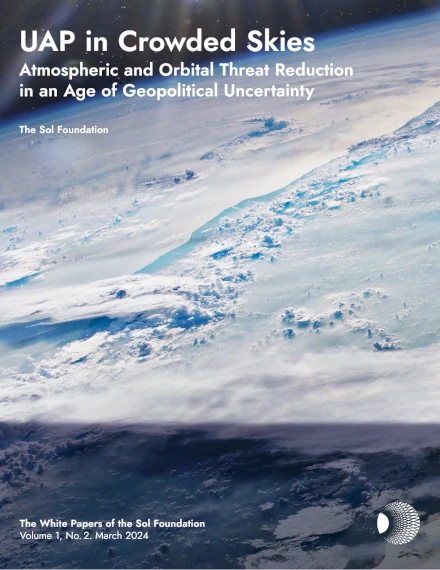
Sol’s early phase centered on organizational launch, public positioning, and the establishment of flagship events. The organization quickly became associated with an annual symposium model that assembled speakers across disciplines and sectors, signaling an intent to operate like a policy-and-research institute rather than a hobbyist UFO group. During this period, Sol also began developing a publication identity through white papers that frame UAP as a governance problem, including the need for reporting reform, oversight structures, and responsible public communication.
Prominence (2024–2025)
Sol’s prominence increased as its symposium programming attracted attention from both UAP enthusiasts and observers interested in whether the topic could be institutionalized responsibly. Media coverage emphasized the unusual coalition—academics, investors, journalists, former officials, and researchers—assembled under a single banner. Publication activity expanded with policy papers that argued for congressional action, disclosure pathways, and research agenda-setting, positioning Sol as a hub that attempts to translate “UAP discourse” into institutional proposals.
Later Work (2025–present)
In later work, Sol continued to internationalize its framing and to refine its role as a convening platform and publisher of policy-oriented documents. Its event programming shifted toward broader geographic participation and longer-term governance questions, including how multiple nations and institutions might coordinate in a world where UAP are treated as a persistent issue. Sol increasingly highlighted early access to symposium talks, expanded publication offerings, and emphasized advisory functions that present UAP as an emerging domain for strategic planning.
Major Contributions
- Institutionalized “legitimacy-first” UAP discourse via curated symposia that connect academics, policy professionals, and UAP-adjacent insiders.
- Produced policy and white-paper outputs advocating disclosure frameworks, oversight reforms, and research governance approaches.
- Expanded UAP framing beyond sightings to “post-UAP world” implications for law, economics, culture, public trust, and scientific incentives.
Notable Cases
Sol is not defined by stewardship of a single iconic case file. Instead, it functions as a meta-level institution: its “cases” are often policy problems (classification, reporting pipelines, oversight gaps) and research problems (data standards, evidentiary thresholds, stigma). Where traditional ufology highlights discrete incidents, Sol highlights the institutional environment that determines which incidents become knowable and studyable.
Views and Hypotheses
Sol’s public posture generally avoids committing to one narrow explanation of UAP, emphasizing that UAP likely represent multiple categories of phenomena and that better data and governance are prerequisites to confident conclusions. At the same time, Sol’s ecosystem overlaps with “nonhuman intelligence” narratives common in disclosure-era discourse, and its events frequently engage the implications of extraordinary possibilities even while emphasizing institutional responsibility and methodological rigor.
Criticism and Controversies
Criticism of Sol typically falls into two camps. Skeptics argue that institutional prestige can amplify claims that remain evidentially weak, that curated networks can become echo chambers, and that “academic branding” can obscure uncertainty. Supporters counter that stigma has historically prevented rigorous inquiry and that institution-building is necessary to improve evidence quality, attract credible participants, and create accountable frameworks for disclosure and research.
Media and Influence
Sol’s influence is shaped by its role as a convening platform: speakers and documents circulate widely through podcasts, social media clips, and long-form interviews, creating “credentialed” reference points for UAP discussions. Its symposium model functions as an agenda-setting mechanism, determining which topics and voices receive legitimacy and which frameworks—policy, governance, data standards, and cultural analysis—dominate the conversation.
Legacy
The Sol Foundation’s long-term legacy will likely depend on whether its institutional approach yields durable outcomes: improved reporting and oversight practices, higher-quality datasets, credible research programs, and a reduction in polarized “believe vs debunk” culture. Regardless of future evidence about UAP itself, Sol represents a defining disclosure-era experiment in professionalizing and institutionalizing a historically marginalized subject.