Introduction
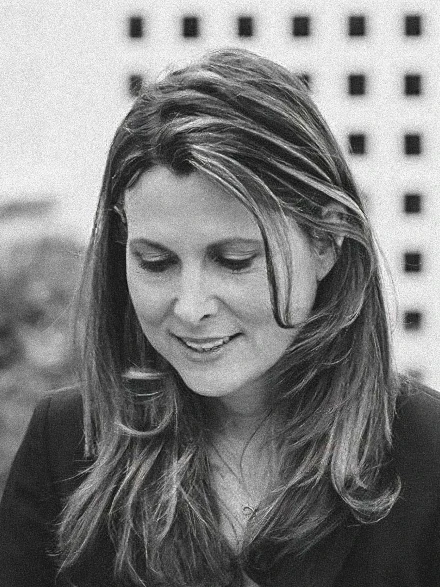
Diana Walsh Pasulka is an American scholar of religion widely recognized for bringing the UFO/UAP phenomenon into serious academic discourse as a subject of contemporary religious imagination, institutional authority, and modern mythmaking. Rather than treating UAP as a physics problem or a purely sociological curiosity, Pasulka approaches the subject as an evolving cultural system: a set of experiences, narratives, texts, objects, and communities that operate in ways comparable to new religious movements. Her work has been influential both inside religious studies and in the wider UAP community, where she is frequently cited for framing “contact,” secrecy, and disclosure as forces that shape belief.
Background
Pasulka’s academic formation is rooted in the study of Catholicism, religious history, and the ways religious meaning is produced through institutions, media, and embodied experience. This training positioned her to notice patterns within UFO culture that resemble older religious forms: testimonies of extraordinary encounters, charismatic authorities, pilgrimages to significant sites, the circulation of “relic-like” materials, and the use of esoteric knowledge as a boundary marker between insiders and outsiders.
She has held a university faculty role in religious studies, where her work is situated within broader scholarship on modern religiosity—particularly how late-modern societies generate new spiritual frameworks under conditions of technological change, mass media, and contested authority.
Ufology Career
Pasulka is not a field investigator in the classical ufology sense. Her “ufology career” consists of ethnographic and interpretive research: interviewing experiencers, mapping networks of belief, analyzing popular texts, and identifying how institutions and professional credentialing shape what counts as legitimate knowledge in UAP discourse. She is known for taking the claims seriously as cultural data without requiring that any specific ontological explanation (aliens, interdimensional beings, secret technology) be true in order for the phenomenon to be important.
A distinctive aspect of her work is attention to “elite belief communities”: professionals with aerospace, engineering, or defense-adjacent backgrounds who privately engage UFO narratives and materials, sometimes treating them as meaningful artifacts. Pasulka’s writing emphasizes how credentialed actors can legitimize a belief system, functioning analogously to religious authorities who certify relics, interpret mysteries, or guard sacred knowledge.
Early Work (2000-2017)
Pasulka’s early scholarship focused on established religious traditions and the mechanics of belief, practice, and institutional history. This period is important because it provided the conceptual tools later used to interpret UFO culture: the relationship between narrative and authority, the role of taboo and secrecy, the dynamics of conversion, and the social life of sacred objects.
As UAP stories became more visible in digital media, Pasulka’s intellectual interests broadened toward contemporary sites where belief is forming rapidly outside traditional religious institutions—online communities, experiencer circles, and hybrid networks of science-minded enthusiasts and spiritual seekers.
Prominence (2018-2020)
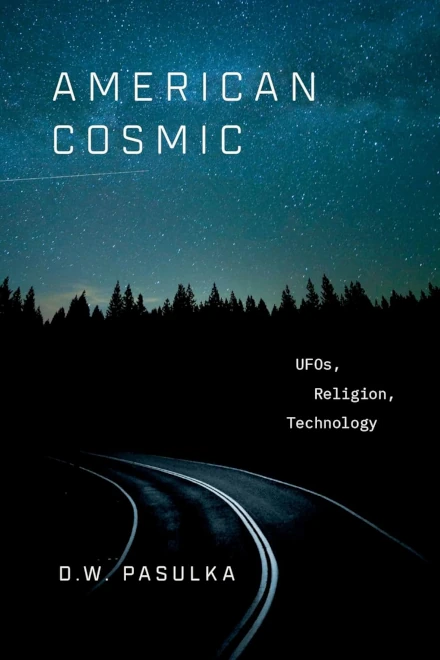
Pasulka’s mainstream prominence in UAP discourse accelerated with the publication of American Cosmic. The book presented UFO belief as an emergent, technology-mediated religious phenomenon and introduced many readers—especially those in skeptical or purely “nuts-and-bolts” ufology—to a different question: not “what is it?” but “what does it do?” In other words, how do UAP narratives transform identity, produce communities, and generate meaning in a modern world saturated with media and secrecy?
This period also established her as a frequent guest in long-form interviews, where she elaborated on themes of modern mythology, the “saint-like” status of certain experiencers or insiders, and the quasi-sacred handling of purported UAP materials and locations.
Later Work (2021-2025
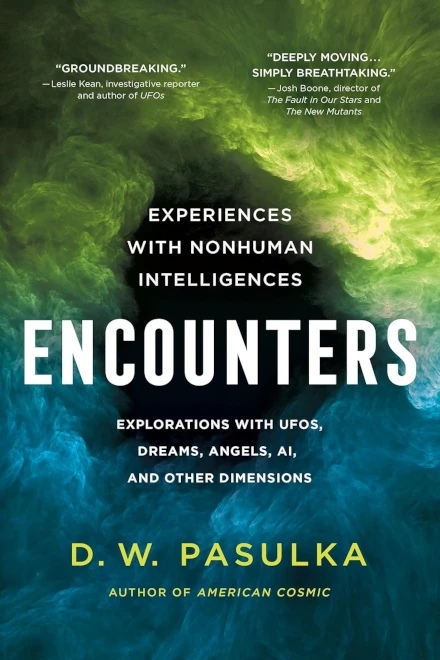
In later work, Pasulka expanded the framework beyond the U.S.-centric “American” context to a broader emphasis on encounter narratives and the formation of new interpretive communities. Her writing increasingly addressed how technology—especially digital media, podcasts, and online archive culture—creates a rapidly evolving canon of stories, where repetition and community validation can function like religious tradition-building.
She also became a reference point in contemporary “disclosure culture,” where governmental ambiguity, leaked claims, and insider testimony produce a religious-like structure of expectation: prophecy, anticipation, disappointment, and renewed faith in the next reveal.
Major Contributions
- Religious-studies reframing of UAP: Positioned UFO belief as a legitimate subject of scholarly analysis rather than a fringe curiosity.
- “Technology as religion” lens: Showed how modern technological institutions (space programs, defense cultures, media systems) can generate sacred narratives.
- Authority and credentialing analysis: Highlighted how insiders and professionals can function as legitimizing priests, saints, or custodians of taboo knowledge.
- Material culture emphasis: Focused attention on “objects” in UAP culture—alleged fragments, artifacts, photos, sites—and how they function socially like relics.
Notable Cases
Pasulka is not defined by a single “case” in the way crash-retrieval or abduction investigators are. Instead, her notable “cases” are interpretive clusters: patterns of experiencer testimony, the social life of alleged UAP materials, and the way certain locations become pilgrimage sites. She is particularly known for discussing anonymized interviews with credentialed individuals who frame UAP as meaningful, and for examining how those claims circulate, gain authority, and become part of a shared canon.
Views and Hypotheses
Pasulka’s core view is that the UAP phenomenon is culturally real regardless of its ultimate ontological explanation. She treats experiences and narratives as data that reveal how modern societies produce meaning under uncertainty. Rather than arguing for a single cause (extraterrestrials, interdimensional entities, advanced secret tech), she emphasizes that multiple interpretive layers operate simultaneously: psychological experience, media amplification, institutional secrecy, and mythic archetypes.
A central hypothesis in her work is that UFO belief behaves like a new religious movement: it generates conversion experiences, charismatic authorities, sacred texts (books, leaked documents, “files”), ritualized media consumption (podcasts, conferences), and moral frameworks about truth-seeking, awakening, and secrecy.
Criticism and Controversies
Critics from skeptical communities argue that treating UAP narratives as religious phenomena risks normalizing weak evidence or granting undue legitimacy to extraordinary claims. Some ufologists criticize the religious-studies approach for “explaining away” the phenomenon as belief rather than addressing the physical question of what UAP are.
From the other direction, some believers criticize Pasulka for academic distance—arguing she analyzes communities without endorsing their strongest claims. Her use of anonymized sources and her attention to elite networks can also be controversial, because it invites speculation about hidden insiders while limiting public verification.
Media and Influence
Pasulka has become one of the most influential academic voices in contemporary UAP culture, particularly through podcasts, interviews, and conference circuits that translate scholarly ideas into accessible frameworks. She has shaped how many audiences talk about disclosure: not merely as an information release but as a culture-forming process that organizes hope, identity, and authority.
Legacy
Diana Walsh Pasulka’s legacy is the normalization of UAP as a legitimate subject for serious humanities scholarship. She provided an enduring vocabulary—religion, relics, saints, pilgrimage, taboo knowledge, mythmaking—that helps explain why the UFO phenomenon persists and evolves even when definitive proof remains contested. For many readers, her work shifted the conversation from “belief versus debunking” toward a deeper inquiry into how modern societies build sacred meaning around technology, secrecy, and extraordinary experience.