Introduction
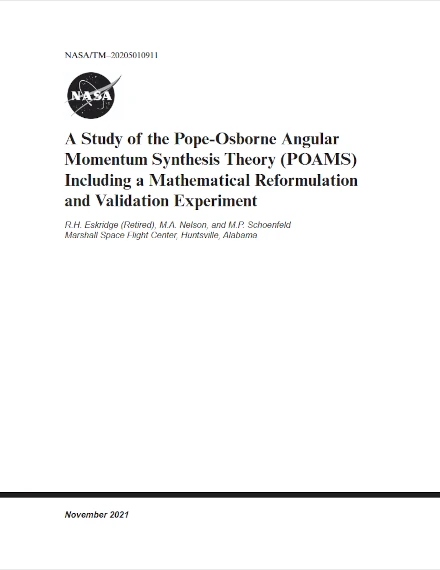
R. H. Eskridge is a NASA-affiliated engineer and technical author associated primarily with the Marshall Space Flight Center (MSFC) in Huntsville, Alabama. Across a multi-decade record of public NASA technical publications and citations, Eskridge appears in work related to plasma physics, propulsion research, and diagnostic measurement in aerospace environments. While not a “ufologist” in the classic sense of investigating sightings, Eskridge’s name has become relevant in ufology-adjacent discourse because of his presence on technical documents that are frequently reinterpreted by “breakthrough propulsion” communities—most notably a NASA technical memorandum addressing Pope–Osborne Angular Momentum Synthesis Theory (POAMS).
Background
Eskridge’s publicly visible career footprint is strongly tied to NASA’s technical-report ecosystem, where engineers and scientists document experimental methods, measurement campaigns, and subsystem development. MSFC has historically served as a major NASA center for propulsion systems, testing infrastructure, and applied research. Eskridge appears in NASA records as an MSFC-affiliated author or co-author on topics including plasmas, optical discharges, and propulsion-adjacent diagnostics. In later references, he is also explicitly labeled as “retired” in the authorship line of a NASA technical memorandum, indicating a career long enough to span multiple generations of NASA propulsion and plasma research priorities.
Ufology Career
Eskridge is not principally known for UFO case investigation, witness interviewing, or ufology organization leadership. His “ufology relevance” is indirect and document-driven: certain audiences interpret NASA-authored or NASA-hosted technical documents as signals of institutional interest in unconventional physics or propulsion mechanisms. In this context, Eskridge’s name appears in modern UAP-adjacent conversation because a NASA technical memorandum associated with MSFC examined POAMS and included discussion of a validation experiment concept. For many enthusiasts, the mere existence of such a report functions as a cultural artifact—used to argue that fringe claims are being taken seriously by mainstream institutions—while skeptics treat it as exploratory documentation rather than confirmation of extraordinary effects.
Early Work (1984–1999)
Eskridge appears in NASA and aerospace literature during the 1980s in connection with experimental plasma studies, including work on optical discharges and laser-supported plasmas. This period reflects an applied research environment where high-energy optical and plasma phenomena were investigated for propulsion-relevant understanding and experimental characterization. The technical emphasis of this phase is broadly consistent with MSFC’s mandate: applied physics and engineering knowledge for spacecraft and engine systems.
Prominence (2000–2015)
In the 2000s, Eskridge’s publication footprint extends into propulsion-adjacent measurement and technology-development contexts. NASA publications list Eskridge among authors in plume/soot diagnostic work relevant to rocket engine exhaust characterization. In parallel, Eskridge appears in electric propulsion development literature, including references tied to the design and construction of prototype thruster concepts and related system designs. A key marker of this period is Eskridge’s association with a plasmoid-thruster coil-system patent record and citations to prototype thruster development work in conference and technical contexts. By the early-to-mid 2010s, Eskridge is also listed among NASA MSFC authors on inductive pulsed plasma thruster-related publications, a domain aligned with electric propulsion roadmaps for specialized mission niches.
Later Work (2016–present
In the later phase of his public record, Eskridge is associated with a NASA technical memorandum (with “retired” indicated in the author line) focused on Pope–Osborne Angular Momentum Synthesis Theory (POAMS), including a mathematical reformulation and a proposed validation experiment. This publication became a point of renewed attention beyond conventional propulsion circles because it intersected with themes popular in fringe propulsion and “gravity modification” communities. Regardless of interpretation, this phase underscores a distinctive feature of Eskridge’s public profile: his name spans both mainstream propulsion/plasma documentation and the boundary-zone literature that nontraditional physics communities frequently cite.
Major Contributions
- NASA technical-report authorship: contributions to MSFC-facing documentation in plasma, propulsion, and measurement/diagnostic domains across decades.
- Electric propulsion development footprint: association with plasmoid/inductive thruster concepts in public patent and publication records.
- Boundary-zone influence via documentation: becoming a frequently cited name in “breakthrough” circles due to the POAMS-focused NASA technical memorandum.
Notable Cases
Laser-supported plasma and optical discharge studies: Eskridge’s earlier record includes experimental work involving plasmas that feed into propulsion and high-energy gas phenomena understanding.
Electric propulsion and plasmoid thruster development: Eskridge appears in contexts describing prototype thruster development and system design, including a coil-system patent record that cites plasmoid thruster work.
POAMS study and validation experiment concept: the NASA technical memorandum on POAMS is the most widely recirculated “notable item” outside traditional aerospace circles, functioning as a magnet for speculative interpretation in alternative propulsion and UAP-adjacent communities.
Views and Hypotheses
Eskridge’s public record is primarily technical rather than philosophical: the most defensible characterization of his “views” comes from the topics he repeatedly engages—experimental characterization, propulsion-adjacent plasma phenomena, and applied engineering documentation. The POAMS memorandum indicates at least a willingness to explore and formalize unconventional theoretical frameworks for evaluation, including proposing pathways for experimental validation. In ufology-adjacent reading, this is sometimes framed as implicit endorsement; in a more conventional reading, it reflects exploratory analysis and the documentation of testable formulations rather than confirmed extraordinary outcomes.
Criticism and Controversies
Eskridge’s name becomes controversial largely by association rather than by personal public campaigning. The controversy centers on how his documents—particularly POAMS-related material—are interpreted. Enthusiast communities may treat the NASA affiliation as an imprimatur that exceeds what the technical report itself can establish, while skeptics argue that publication or hosting in a NASA repository does not prove that the extraordinary claims implied by some interpretations have been experimentally verified. In electric propulsion contexts, debates tend to be less sensational and more technical: what is feasible, what is scalable, and what has demonstrable performance data in controlled environments.
Media and Influence
Eskridge’s influence is mostly “document-mediated.” Unlike public-facing ufology personalities, his visibility is driven by technical reports, citations, and patent/publication records that others discuss and repackage in podcasts, forums, and UAP/antigravity commentary videos. This produces a distinctive footprint: an engineer whose public persona is largely constructed by downstream interpretation of formal documents rather than by a personal media career.
Legacy
R. H. Eskridge’s legacy rests on two overlapping domains. Within the NASA technical ecosystem, he is part of the long continuum of MSFC engineers who documented applied plasma and propulsion-related work across decades. Within ufology-adjacent and “breakthrough propulsion” communities, he is remembered as a name attached to unusually provocative documents—especially the POAMS memorandum—making him a recurring reference point in arguments about whether unconventional propulsion concepts are quietly being evaluated inside mainstream institutions.