Introduction
Henry William Wallace is best known for a cluster of U.S. patents issued in the early 1970s that describe experimental systems intended to generate, shape, and detect what he termed a kinemassic force field—presented as a dynamic, gravity-like interaction associated with the motion of matter, particularly where nuclear spin properties of materials are emphasized. Although the patents have had outsized influence in ufology-adjacent “antigravity” and “exotic propulsion” literature, Wallace’s ideas remain scientifically contested and are typically treated as unverified or speculative outside niche research communities.
Background
Public summaries that reference Wallace commonly describe him as working within the General Electric corporate ecosystem (often specifically GE Aerospace and associated re-entry systems work). In ufology and alternative-propulsion circles, this corporate affiliation is frequently used to frame his patent work as emerging from, or at least adjacent to, mainstream aerospace engineering culture—though the patents themselves are the primary durable public record, and biographical detail is comparatively sparse.
Ufology Career
Wallace was not a “ufologist” in the conventional sense of an investigator focused on sightings, contact claims, or government disclosure. Instead, his relevance to ufology stems from how his patents became canonical citations in arguments that (1) gravity-like fields might be technologically engineered, and (2) aerospace organizations may have pursued unconventional field physics. As a result, Wallace is often grouped with “electrogravitics” and “breakthrough propulsion” narratives, where patents are treated as clues to hidden research programs.
Early Work (1960s–1971)
Accounts situating Wallace’s patents within a broader lineage typically connect them to mid-20th-century interest in gravitomagnetism, rotating-mass effects, and proposals that certain materials might exhibit field-like responses under rotation. In Wallace’s framing, materials with specific nuclear-spin characteristics are central, and the experimental apparatus is presented as a practical method to produce measurable effects.
Prominence (1971–1980)
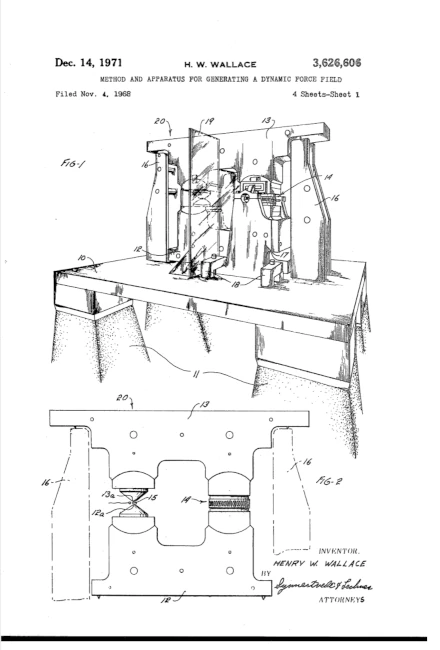
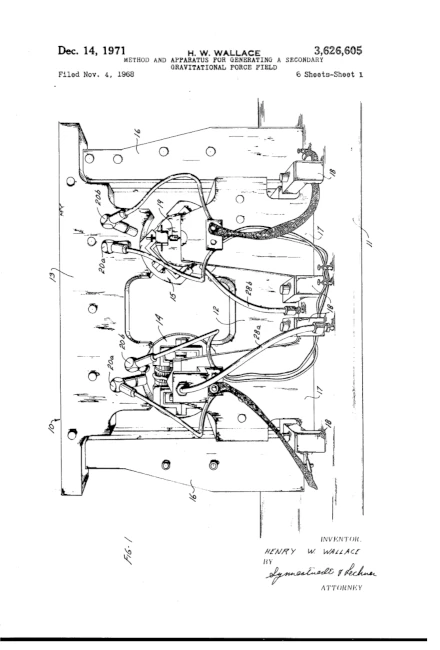
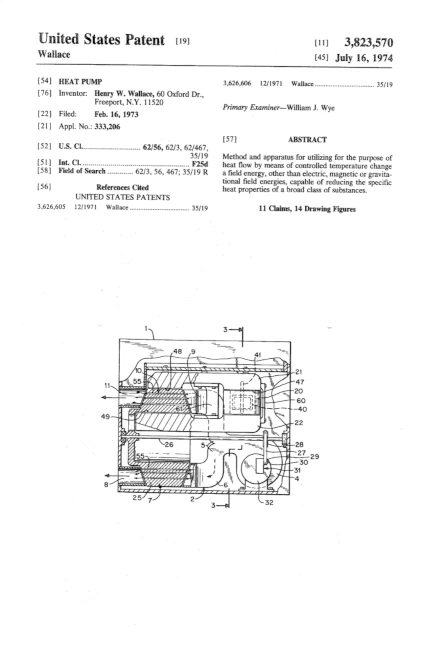
Wallace’s prominence is primarily anchored to the issuance of three U.S. patents between 1971 and 1974. In these documents, he describes: (a) a method and apparatus for generating a secondary gravitational force field; (b) a method and apparatus for generating a dynamic force field; and (c) a “heat pump” concept tied to field-induced changes in thermal behavior. These patents were later discussed in secondary summaries as part of the broader “exotic propulsion” discourse, including popular-science commentary that portrayed the patents as intriguing yet controversial.
Later Work (1981–present record)
After the initial patent period, Wallace’s direct published footprint becomes limited in widely accessible sources. However, his patent corpus continued to circulate in technical and semi-technical communities, inspiring commentary, speculative engineering proposals, and occasional attempts at replication. In this later phase, Wallace’s influence is less about ongoing public work and more about the afterlife of the patents as reference documents and debate catalysts.
Major Contributions
- Patented “kinemassic field” generation and detection concepts: a set of designs asserting a secondary gravity-like field associated with rotation and material nuclear-spin properties.
- Codified a vocabulary and apparatus style for “secondary gravitational” claims: including field-circuit language, shielding/flux analogies, and instrument-like diagrams that readers interpret as engineering-forward presentation.
- Influenced electrogravitics and breakthrough-propulsion subcultures: providing a frequently cited patent-based anchor for claims of gravity-control feasibility.
Notable Cases
Rather than “cases” in the investigative ufology sense, Wallace’s “notable cases” are best understood as (1) the patents themselves and (2) later efforts to interpret or experimentally probe the claims. In later technical literature, Wallace’s rotating-mass apparatus is sometimes referenced as a historical template for replication-style testing, typically framed as an attempt to detect small anomalous forces or field-like interactions under controlled rotation conditions.
Views and Hypotheses
Wallace’s patent language presents the kinemassic/dynamic field as a non-electromagnetic interaction associated with motion, often described in terms meant to evoke gravitational coupling and relativistic analogies. A recurring hypothesis is that rapidly rotating materials with particular nuclear-spin characteristics could become “polarized” in a way that produces a measurable secondary field, which might then be detected mechanically (via changes in motion), electrically (via transverse voltages), or thermally (via changes in material heat behavior).
Criticism and Controversies
Criticism centers on reproducibility and theoretical plausibility: the patents are frequently cited as lacking publicly available independent verification of working devices, and the claimed effects—if any—are generally characterized as expected to be small. Consequently, Wallace’s work sits in a contested space: to proponents, the patents suggest suppressed or overlooked physics; to critics, they represent speculative extrapolation without compelling experimental confirmation.
Media and Influence
Wallace’s influence is disproportionately mediated through secondary discussion: popular-science commentary, alternative-propulsion compilations, and online technical forums frequently treat the patents as a touchstone. In ufology-adjacent ecosystems, Wallace is often invoked alongside broader narratives about classified propulsion research, “antigravity” rumors, and the idea that patent records may provide indirect evidence of unconventional R&D interest.
Legacy
Wallace’s lasting legacy is the endurance of his early-1970s patents as “foundational documents” within electrogravitics and exotic-propulsion lore. Regardless of whether the claimed effects are ultimately substantiated, his work continues to shape how nonstandard gravity-control proposals are written, diagrammed, and argued—especially in communities that treat patents as a bridge between speculative physics and putative aerospace applications.