Introduction
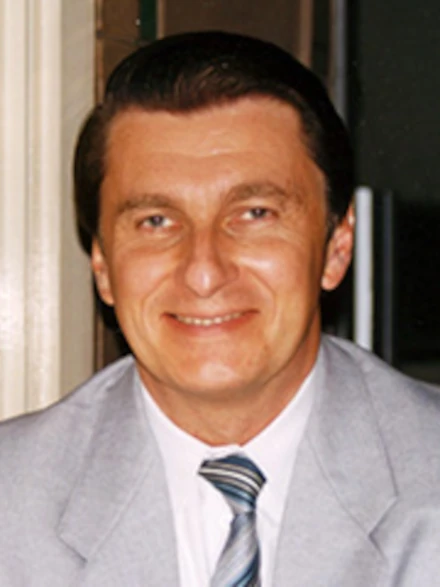
Eugene (Evgeny) Podkletnov is a physicist best known for extraordinarily controversial claims involving superconductors and gravity. In the mid-1990s he reported that a rotating, levitated superconducting disc could produce a small reduction in the apparent weight of objects placed above it—an effect widely dubbed “gravity shielding” or the “Podkletnov effect.” In later years, he was also associated with claims of impulse-like gravitational phenomena generated by high-voltage discharges. These assertions placed Podkletnov at the center of a persistent scientific and cultural controversy: whether unusual condensed-matter systems might couple to gravity in detectable ways, or whether the reported effects reflect measurement error, uncontrolled artifacts, or misinterpretation.
Background
Podkletnov’s early scientific profile is rooted in materials and superconductivity research. The 1990s saw intense interest in high-temperature superconductors and their exotic macroscopic quantum behavior. Superconductors exhibit unusual electromagnetic properties—flux pinning, Meissner expulsion, high current densities, and complex interactions with magnetic fields—making them a fertile environment for experimental artifacts as well as legitimate surprises. Within this context, Podkletnov’s claims stood out because they implied an interaction not merely with electromagnetism, but with gravity—an interaction far outside what conventional theory predicts for laboratory-scale materials.
Ufology Career
Podkletnov is not a ufologist in the sense of investigating UFO sightings. His relevance to ufology and UAP culture is indirect but substantial: “gravity control” is a recurring explanatory trope invoked to rationalize extreme UAP performance claims (rapid acceleration, silent hovering, lack of apparent propulsion). As a result, Podkletnov became a symbolic figure in UAP-adjacent discourse—frequently cited as evidence that suppressed or frontier physics might enable nonconventional propulsion. In this ecosystem, his experiments are treated as either a near-breakthrough suppressed by orthodoxy or as a cautionary tale of extraordinary claims outpacing verification.
Early Work (1992-1996)
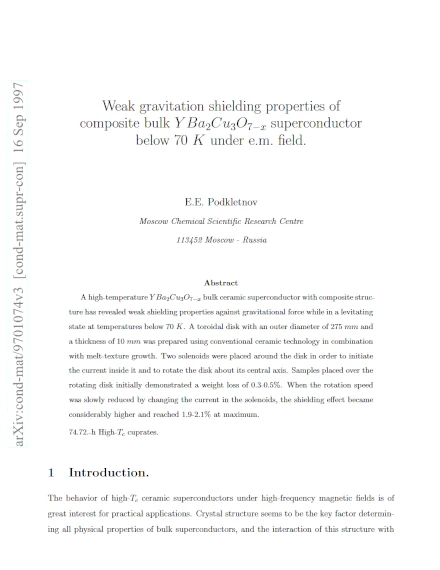
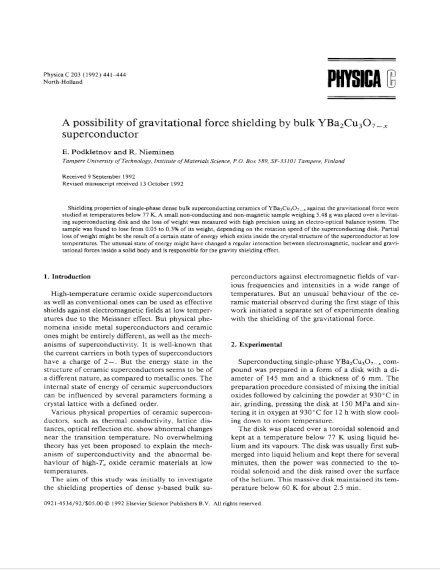
Podkletnov’s earliest and most famous claim emerged from experiments involving a high-temperature superconducting disc—often described in accounts as large, ceramic, and magnetically levitated—spun at high speed in the presence of strong electromagnetic conditions. He reported that objects suspended above the apparatus exhibited a small decrease in apparent weight. The effect was claimed to be position-dependent (within the column above the disc) and only present under particular operating conditions such as rotation and superconducting state.
From the outset, the claim generated fascination because it appeared to violate the equivalence principle and the expected weakness of gravity at laboratory scales. At the same time, it triggered skepticism because the experimental environment—rotation, cryogenics, strong fields, vibration, air currents, and magnetic interactions—can produce subtle forces that mimic weight changes on sensitive balances. The early phase therefore became defined by a dual dynamic: excitement over a “new coupling” versus the difficulty of eliminating mundane confounds.
Prominence (1997-2003)
After the initial reports circulated, Podkletnov’s prominence expanded beyond specialist materials science into the wider world of speculative propulsion research and popular science media. The idea of “gravity shielding” became an anchor claim: even a small verified effect would have revolutionary implications. This period also saw attempts—publicly and privately discussed—to replicate or evaluate the claims. Some accounts described partial or inconsistent reproduction attempts; other efforts reported null results or concluded that instrumentation artifacts were likely.
In this era, Podkletnov’s name became increasingly detached from the original laboratory setting and attached to broader narratives about institutional resistance, funding scarcity, and alleged suppression. His case became a template for “forbidden physics” storytelling, where the absence of clear replication could be interpreted either as disproof or as evidence of secrecy barriers.
Later Work (2004-2025
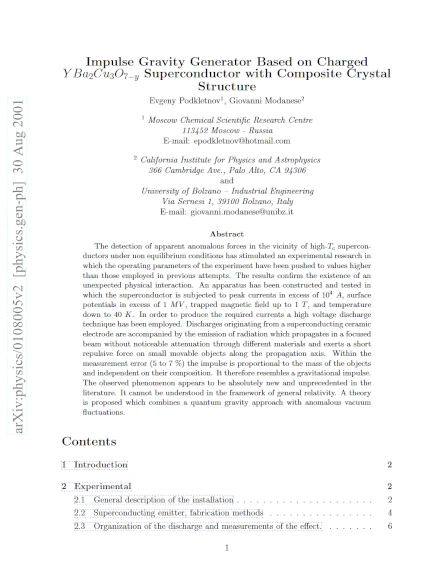
In later years, Podkletnov was repeatedly linked to claims of “gravity impulse” phenomena—sometimes described as a directed impulse associated with high-voltage discharge equipment. In this narrative, gravity is not merely “shielded” but manipulated in a way that can impart momentum to distant targets. Such claims, if true, would be even more radical than the original weight-reduction report.
However, the same structural problem persisted: robust, independent replication in open scientific literature remained elusive. Podkletnov’s later public footprint was therefore shaped as much by what was not conclusively shown as by what was claimed. In UAP and exotic-propulsion communities, his name remained a frequent reference point—invoked as “evidence that weird gravity might be possible”—while in mainstream physics his claims remained largely outside accepted knowledge due to the replication and methodological concerns.
Major Contributions
- The “Podkletnov effect” claim: Helped define a modern genre of gravity-modification experimentation focused on superconductors and rotation.
- Stimulus for replication attempts: Motivated numerous researchers and hobbyists to examine whether balances, EM interference, vibration, and airflow can create false “weight change” signals.
- Cultural impact on exotic propulsion: Became a cornerstone citation in antigravity and UAP-adjacent narratives about nonconventional flight physics.
Notable Cases
Podkletnov’s “case” is essentially a single evolving experimental storyline:
- Rotating superconductor weight-reduction reports: The original gravity-shielding narrative that launched his notoriety.
- Discharge/impulse claims: Later assertions that gravity-like impulses could be generated and directed.
Unlike sighting-based ufology, the “notability” here is experimental controversy: whether these effects exist at all and whether they can be measured reliably.
Views and Hypotheses
Podkletnov’s reported framing implies that under certain conditions—especially involving superconductivity, rotation, and strong electromagnetic environments—matter might produce unusual gravitational interactions not described by standard approximations. Depending on the retelling, the hypothesis ranges from “a small shielding-like reduction in gravitational coupling” to “a field/impulse that can transfer momentum.” Such claims sit far outside mainstream expectations because general relativity does not predict macroscopic gravity shielding, and known condensed-matter physics does not provide an established mechanism for large gravitational modulation.
Criticism and Controversies
The central criticism is methodological and evidentiary: extraordinary effects require extraordinary controls. Superconductor experiments are notoriously vulnerable to artifacts—magnetic forces acting on nearby metal, vibrational coupling into scales, acoustic or airflow effects, electrostatic charging, RF interference, thermal gradients, and subtle mechanical torques. Skeptics argue that without exhaustive instrumentation transparency and independent replication, the most likely explanation is experimental artifact or mismeasurement.
Supporters counter that anomalies can be real even if hard to reproduce, especially if the operating regime is narrow or the apparatus is difficult to build. They also argue that institutional risk aversion and stigma can prevent the sustained funding needed to resolve such claims definitively. This tension—artifact versus suppressed anomaly—is the defining controversy of Podkletnov’s legacy.
Media and Influence
Podkletnov’s influence is unusually large relative to the confirmed scientific status of his claims. He is a staple reference in books, documentaries, and online communities focused on antigravity, breakthrough propulsion, and UAP explanations. The name “Podkletnov” functions as shorthand for the idea that laboratory-scale gravity anomalies might be possible—often cited alongside other disputed figures and projects in the same cultural orbit.
Legacy
Eugene Podkletnov’s legacy is that of a controversial boundary figure whose claims became foundational to modern antigravity mythology. To skeptics, he exemplifies how experimental artifacts and sensational retellings can create durable legends. To proponents, he remains a symbol of a potentially real but institutionally marginalized frontier. Regardless of interpretation, his story continues to shape how the public imagines the relationship between superconductors, gravity, and the possibility of exotic propulsion.