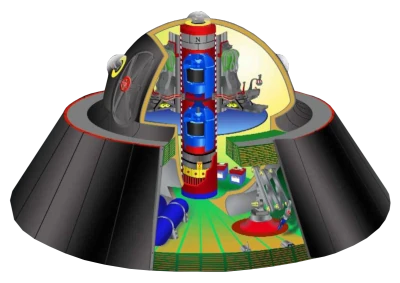
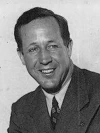
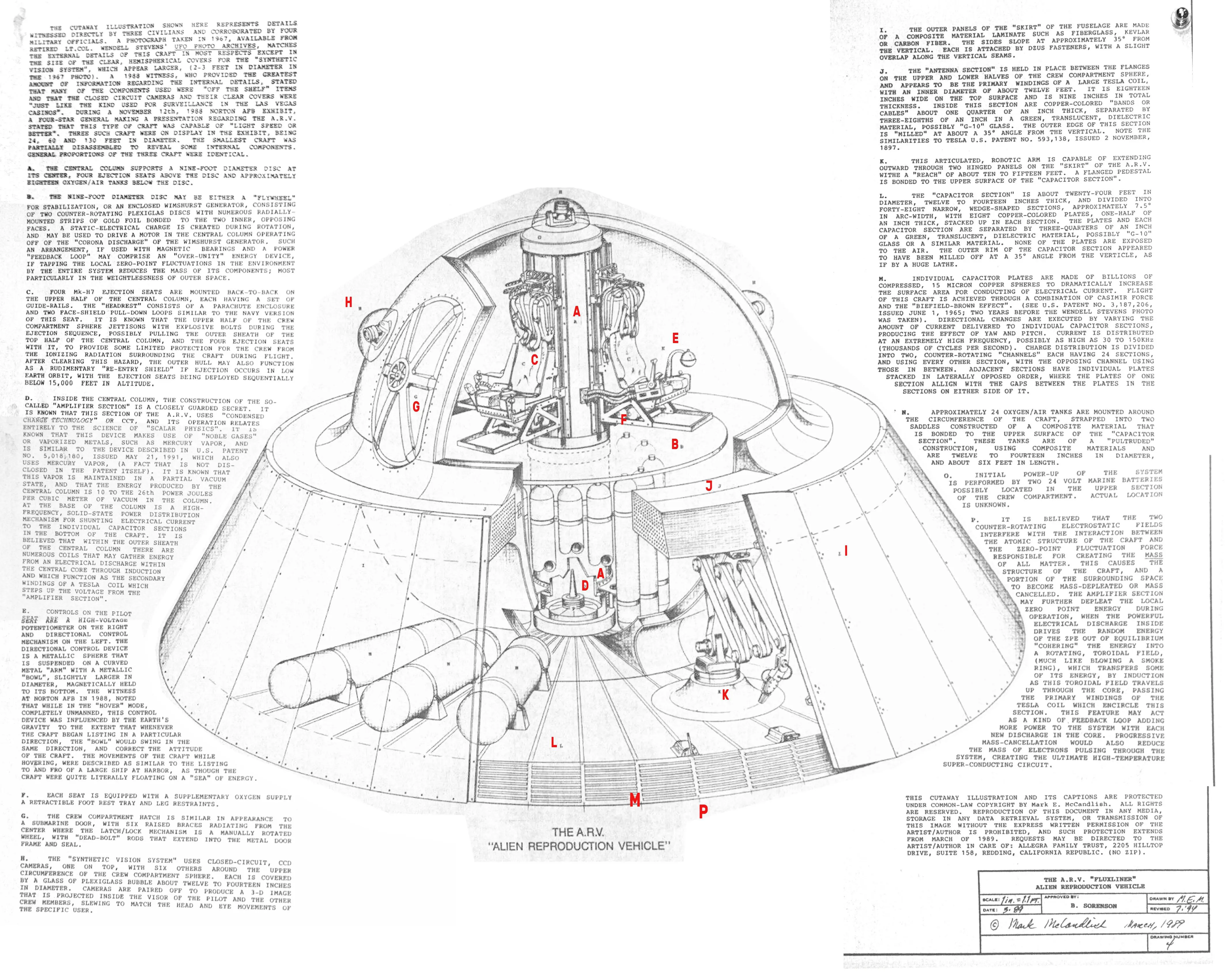
The alleged firsthand source behind the leak of the "Alien Reproduction Vehicle" aka "Fluxliner" that he told to fellow aerospace designer Mark McCandlish, and later Gordon Novel, that he witnessed at a presentation for VIP at Norton Air Force Base in 1988.
"Brad" visited the base for an air show with a high level DoD client, rumored to be Frank Carlucci, who passed him off as an aide to see the VIP presentation in a hanger at the air base during the air show.
In addition to producing a line art blueprint he also reported on the ARV's components as revealed by the general giving the presentation. The general stated the ARV could exceed the speed of light.
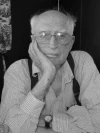
For decades Mark has been the public face for the leak of the "Alien Reproduction Vehicle" aka "Fluxliner" by fellow aerospace designer colleague "Brad".
First gained notoriety at the Disclosure Project Press Club Briefing in 2001 where he displayed the line art blueprint of the ARV.
Mark spent decades conducting research attempting to decipher the ARV's propulsion and energy systems to fully understand how the ARV functions and sharing that information with the world in interviews and documentaries.
Lockheed Martin Senior Scientist with 30 public patents while there and a research engineer at Hughes Aircraft, General Dynamics and Texas Instruments over his 40 year career.
In his deathbed confession he claimed to have worked with aliens from a star system approximately 68 light years from Earth while at Lockheed Martin.
Collected significant experimental evidence of Inertia Reduction or Asymmetric Vacuum Pressure with magnets moving in the direction of their North to South pole inspired by the claims of Boyd Bushman and Mark McCandlish
Experimental evidence collected consistently shows a magnet in free-fall in the direction of its North to South pole accelerates at rates greater than gravity in free-fall experiments.
Latest experiment consists of a dual drop free-fall experiment from approximately 50ft with magnet falling in the direction of its North to South pole and a non-magnetic, non-conductive, Control object of similar mass.
Propellantless propulsion pioneer best known for the Biefeld–Brown effect where high voltages applied to a capacitor will cause the capacitor to move in the direction of the negative to positive electrode.
In 1929 "Science & Invention" printed an article "How I Control Gravitation" by Brown about an experiment that weighed over 88lbs that displayed the effect disputing claims the effect is ion wind. Brown believed he had found a link between electricity and gravity.
The Montgolfier Project reveals Brown worked with the French company SUD Aviation in the 1950s and revealed to them that dynamic applications (pulsed DC voltages) of the BB effect were now classified by the U.S. government.
Conducted a study "Twenty First Propulsion Concept" for the Air Force on the Biefeld-Brown effect inside a vacuum chamber in 1991 with both static and pulsed DC voltages of 19kV up to 600Hz.
With acrylic between the electrodes only the highest voltage and highest pulse rate displayed a force above measurement threshold while with PZT forces were detected when electrical pulsing through the PZT occured.
Under "Recommendations" at the end of the report, Talley called for additional experimentation using higher pulsed DC voltages applied to high dielectric constant materials like PZT to further verify measured anomalous forces.
Worked with the Honda R&D Institute on a Biefeld-Brown effect experiment with a custom built capacitor that was set in inulating oil to eliminate any affects that would be due to ion wind.
Two test voltages were used, 18kV static DC and 8kV pulsed DC 50Hz pulse rate. The capacitor performed better with pulsed DC losing 2 grams, about 3% of its weight, versus 0.5 grams when static DC was applied.
Has done considerably theoretical work in an attempt to come up with an equation to determine the capacitor build specs needed for propulsive forces over a 1km/sec.
Conducted a study "Asymmetrical Capacitors for Propulsion" for NASA on the Biefeld-Brown effect inside a vacuum chamber in 2004 with a static DC voltage of up to 50kV. Pulsed voltages were not tested.
Of the four capacitors tested only one used a solid dielectric in between the electrodes and it was also the only one that moved when the initial pulse of static DC current was applied to the capacitor when the power supply was turned on.
An arc occured at these moments and the capacitor would rotate an eighth of a rotation. The movement was dismissed as an ejection of material during the arc but no explanation was given why no arcs and movement occured with the other capacitors.
A GE Aerospace engineer who discovered the spin of unpaired nucleons can be polarized through high speed rotation the same as the spin of unpaired electrons can creating a field that is not electromagnetic in nature unlike polarized electrons.
Discovered atoms with an unpaired proton or neutron have a permiability to this force akin to some atoms having a magnetic permiability.
Discovered polarized unpaired nucleons can be used to shield a craft from external gravitational fields as well as creating gravitational fields inside such a craft.
A decade after Wallace published his patents on spin polarization of unpaired nucleons to generate a force Alzofon wrote the book "Gravity Control with Present Technology" where he called using "Dynamic Nuclear Polarization" to affect gravity.
Alzofon believed that by aligning the spins of unpaired nucleons propulsive forces can be generated.
Alzofon paved the way for later scientists like Podkletnov, Li, and Eskridge to conduct experiments, in their cases, with superconductors and high speed rotation, as another method to polarize the spin of unpaired nucleons.
Discovered a rotating superconducting disc, composed in part of atoms with unpaired nucleons and rotated at approximately 5,000 rpms, had a gravity shielding effect above the disc. No one has attempted to replicate this experiment in full.
Experimented with a larger gold plated aluminum disc rotated at higher rates up to 12,000 rpms which had an even greater propulsive and shielding force. Both gold and aluminum atoms have an unpaired proton.
Discovered an impulse beam force by wrapping an electromagnetic coil around a superconducting emitter and discharging a pulse up to 4 Megavolts through the emitter to a receiver. The impulse beam was recorded travelling faster than the speed of light.
A physicist like Podklenov who became famous in the 1990s for conducting experiments with rotating YBCO superconductors some atoms of which have unpaired nucleons and generated measurable “gravitomagnetic” fields.
Formed company AC Gravity that received a U.S. government grant to continue her work at which point all her work went dark.
In an interview her son stated she suffered depression over the inability to discuss her work with the scientific community as a result of the U.S. government grant's stipulations.
Conducted an experiment for NASA where his team constructed and rotated a disc of Bismuth at high rpm, an atom with an unpaired proton, and discovered it gained and lost weight depending on the direction of rotation of the disc.
NASA Marshall Space Flight Center engineer/researcher associated with propulsion- and plasma-adjacent technical work across multiple decades, including laser-supported plasma experiments and diagnostics.