Introduction
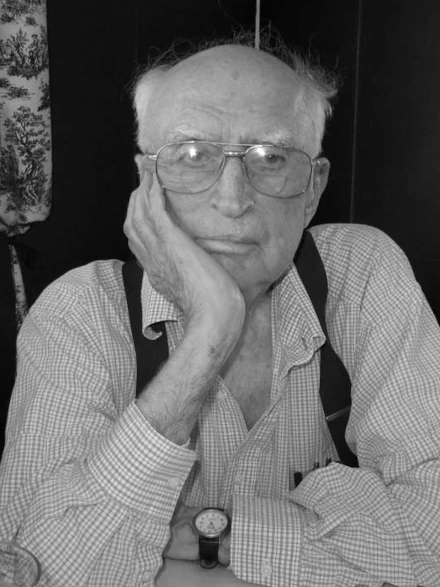
Frederick E. Alzofon (1919–2012) was an American physicist and independent gravity-control theorist whose work became widely known in alternative propulsion and ufology-adjacent communities under the banner of “anti-gravity with present technology.” Alzofon’s reputation rests on a distinctive thesis: that gravity is not merely a geometric property of spacetime (as in general relativity), but is intimately tied to subatomic processes—particularly the organization and polarization of nuclear spin systems—and that under carefully engineered conditions the effective gravitational interaction of a material system might be measurably altered. While Alzofon did not function as a classical “ufologist” investigating sightings, he became a cornerstone figure for UAP-oriented audiences because his proposed mechanisms resemble the “inertia control” or “field propulsion” often attributed to extraordinary craft performance.
Background
Alzofon’s formal identity was that of a physicist whose broader technical career extended into mainstream domains such as optics, heat conduction, and applied physics problems. In his later years, he became increasingly focused on first-principles gravity questions, developing a personal theoretical framework intended to bridge gravitation with electromagnetic and quantum-scale processes. This dual identity—mainstream technical competence paired with a highly unconventional gravitational thesis—helped position Alzofon as an “insider-outsider” figure: a credentialed physicist whose most famous ideas circulated primarily outside conventional academic gravity research.
Ufology Career
Alzofon’s “ufology career” is indirect and intellectual rather than investigative. His significance within ufology stems from the persistent premise that UAP performance characteristics—extreme acceleration, silent hovering, abrupt directional changes—would likely require propulsion beyond reaction mass and conventional aerodynamics. Alzofon’s proposed pathway to gravity control and inertial modification became a ready-made theoretical scaffold for this premise. Over time, his name was integrated into a lineage of “breakthrough” thinkers (electrogravitics, vacuum engineering, inertial manipulation) who are often cited as providing the missing physics behind flying-saucer narratives.
Early Work (1940–1980)
Alzofon’s early-to-mid career appears to have been rooted in applied physics and engineering-adjacent research, with interests spanning practical measurement and physical modeling. During this phase he cultivated the mathematical and experimental mindset that would later characterize his gravity-control proposals: a willingness to treat fundamental forces as potentially engineerable phenomena rather than fixed background constraints. By the late 1970s he was developing the core arguments that would be formalized in his 1981 propulsion-conference publication, framing gravity as a process-dependent interaction that might be modulated by internal ordering within matter.
Prominence (1981–1999)
Alzofon’s prominence within alternative propulsion culture begins decisively with his 1981 paper, “Anti-Gravity with Present Technology—Implementation and Theoretical Foundation”, presented within the orbit of professional propulsion-conference proceedings. The paper’s framing was provocative: it proposed that gravity could be approached semi-empirically using accepted features of subatomic processes and that a technological implementation pathway was conceivable. In subsequent years, Alzofon’s ideas continued to circulate through niche technical communities, private correspondence networks, and later internet archives, becoming a recurring citation whenever “antigravity” discussions sought an origin point that looked more technical than purely speculative.
Within this era, a second pillar of Alzofon’s later reputation also formed: claims that processes related to nuclear spin ordering could reduce effective weight. This narrative became especially influential after accounts emerged describing a 1990s-era experiment in which a sample subjected to specific excitation conditions reportedly showed anomalous weight behavior—an episode that later became known broadly as the “Alzofon experiment.”
Later Work (2000–2012
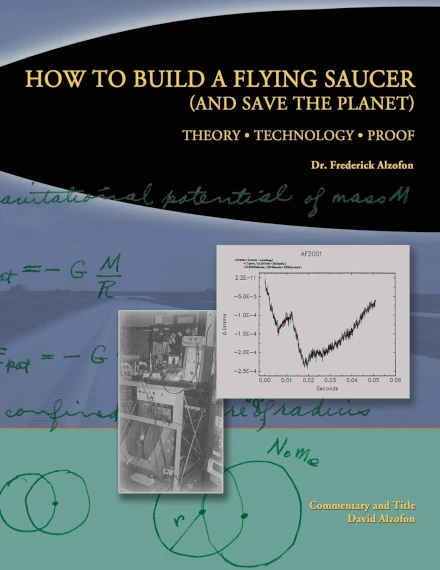
In Alzofon’s later years, his gravity model and its proposed engineering implications were increasingly curated, expanded, and promoted through family and collaborator channels—especially through edited publications that presented his theory as both a theoretical framework and a practical technological roadmap. In this period, Alzofon’s work became more explicitly entangled with UAP/“reverse engineering” narratives, in which his proposed gravity-control mechanism was treated as the “physics key” that could unify reported craft capabilities with a plausible device-level concept. This synthesis—gravity control via nuclear spin dynamics + UAP performance folklore—cemented his posthumous fame.
Major Contributions
- Anti-gravity as an engineering program: articulated gravity control not as distant speculation, but as a near-term technological project rooted in material-state manipulation.
- Nuclear-spin ordering thesis: advanced a model in which changes in subatomic ordering/disordering (often discussed via nuclear spin polarization) could modulate gravitational interaction.
- A durable “breakthrough” reference set: produced papers and a conceptual framework that became foundational citations across electrogravitics, UAP propulsion commentary, and fringe physics forums.
Notable Cases
The 1981 propulsion-conference paper: Alzofon’s “Anti-Gravity with Present Technology” remains the single most-cited artifact associated with his name, often treated as a technical “anchor” for later gravity-control claims.
The “Alzofon weight-reduction experiment” narrative: Later accounts describe a 1990s-era claim of anomalous weight behavior in an experimental setup involving excitation conditions interpreted through Alzofon’s framework. This became a centerpiece story in gravity-control circles and is frequently referenced in modern discussions of nuclear-spin-driven inertia modification.
Views and Hypotheses
Alzofon’s central hypothesis can be summarized as a process-dependent gravity model: gravitational interaction is not merely an immutable property of mass-energy, but is influenced by the internal microscopic state of matter—particularly the degree of ordered versus disordered subatomic dynamics. Within this view, inducing controlled changes in that internal state (commonly framed as cyclic polarization processes or nuclear spin ordering) could reduce the effective gravitational coupling of a system, producing apparent weight reduction. Alzofon’s writings and later presentations of his work often position this as a bridge between quantum-scale processes and macroscopic force behavior, implying that “inertial mass reduction” could be engineered through specialized electromagnetic excitation, resonance, and material selection.
Criticism and Controversies
Alzofon’s gravity-control claims are highly controversial, largely because extraordinary macroscopic effects demand robust, independently replicated evidence. Critics have argued that reported weight changes in experimental narratives can plausibly arise from measurement artifacts, temperature gradients, buoyancy shifts, vibration, electromagnetic coupling into scales, or other systematic errors that mimic “anomalous weight” if not tightly controlled. A key modern flashpoint is replication-oriented analysis suggesting that apparent mass/weight changes can ultimately trace to thermal effects rather than true gravity modification. Supporters counter that the experimental parameter space is complex and that partial replications do not exhaust the possible configurations that might reveal a genuine effect.
Media and Influence
Alzofon’s influence is disproportionately mediated through documents and downstream interpretation rather than direct public media presence. His ideas circulate via edited books, online archives of older technical papers, and UAP-adjacent channels that treat gravity control as the missing piece of advanced craft performance. In recent years, his name has appeared frequently in “UFO physics” content ecosystems where nuclear spin polarization and vacuum engineering are discussed as practical engineering levers. This has made Alzofon a recurring “citation name” in the same way more famous figures become symbolic: invoked to legitimize a concept by association with a technically framed origin story.
Legacy
Frederick Alzofon’s legacy is that of a polarizing pioneer figure in alternative gravity engineering. To supporters, he represents an overlooked path toward controlled gravity and inertial modification—an approach that, if validated, would transform propulsion, energy, and transportation. To skeptics, he represents a cautionary tale about how technical language and partial experimental anomalies can be over-interpreted into world-changing claims without decisive controls and reproducibility. Regardless of stance, his name remains embedded in the modern “breakthrough propulsion” canon and continues to shape how UAP-adjacent audiences imagine the physics behind extraordinary flight.