Introduction
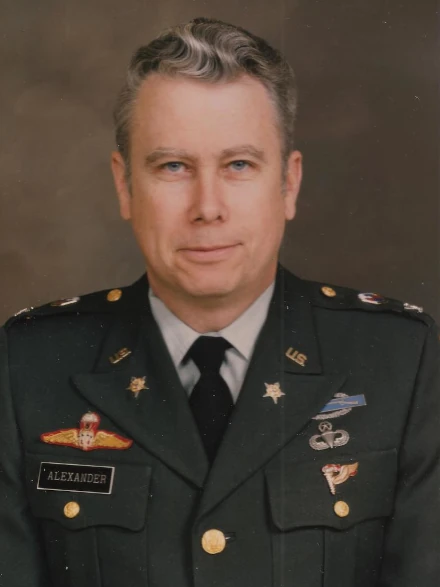
John B. Alexander (born 1937) is a retired United States Army colonel whose public reputation spans three unusually overlapping domains: (1) mainstream military modernization efforts—especially the rise of non-lethal weapons as a distinct capability area, (2) the shadow-history of the U.S. national security state’s flirtations with parapsychology and “human potential” programs, and (3) a long-running, insider-adjacent engagement with the UFO/UAP question as both a policy problem and a cultural minefield. Unlike classic “boots-on-the-ground” ufologists who are defined by case-file investigations, Alexander is best understood as a boundary figure: a career military officer who later became an author, lecturer, and connector among defense, intelligence-adjacent, and anomalous-phenomena communities.
Background
Alexander’s public biography identifies him as an Army “mustang” who enlisted in the 1950s, rose through the ranks, and ultimately retired as a colonel in 1988. He later became known as an advocate for non-lethal weapons development and as a personality willing to engage topics many officials avoided, including psi research, “new age” influences on military experimentation, and the persistent public fascination with UFO claims. Over time, Alexander’s education and professional résumé became part of his credibility narrative in UAP and fringe-science circles: he is often framed as a credentialed insider who knows how the system works and how unconventional ideas can circulate inside it.
Ufology Career
Alexander’s ufology footprint is primarily institutional and interpretive rather than field-investigative. He has written and lectured on UFOs and positioned the topic as something that cannot be reduced to a single simple explanation. His central contribution to ufology culture is not a signature landing case but a framing: the UFO problem is a layered mixture of true anomalies, misidentifications, bureaucratic secrecy, cultural myth-making, and the human tendency to project meaning into ambiguity. This framing—especially when delivered by someone with military status—has been influential in UAP-era debates where audiences struggle to separate sensational narrative from verifiable fact.
Early Work (1956–1984)
Alexander’s early career was anchored in conventional military service, including infantry and Special Forces-adjacent identity in public summaries. This period matters in later ufology discourse because it establishes the “serious operator” persona that many audiences find persuasive: the idea that he is not a purely speculative storyteller, but someone formed in pragmatic, outcomes-driven environments. While his later anomalous-phenomena interests would become famous, they are best understood as emerging from a broader Cold War ecosystem where defense institutions experimented widely—sometimes rationally, sometimes opportunistically—when facing uncertainty about adversary capabilities.
Prominence (1985–2004)
By the mid-1980s and into the post-service years, Alexander became increasingly visible as a proponent of non-lethal weapons and as a participant in networks that explored unconventional ideas. In UAP lore, this era is often associated with the claim that Alexander helped convene or participate in interagency discussions that examined anomalous phenomena and whether any evidence justified targeted R&D. In the public record, this role is frequently referenced under labels such as an “Advanced Theoretical Physics” group/conference—an idea that later authors cite in UAP policy narratives as a precursor to modern UAP-focused task forces and studies.
Later Work (2005–present
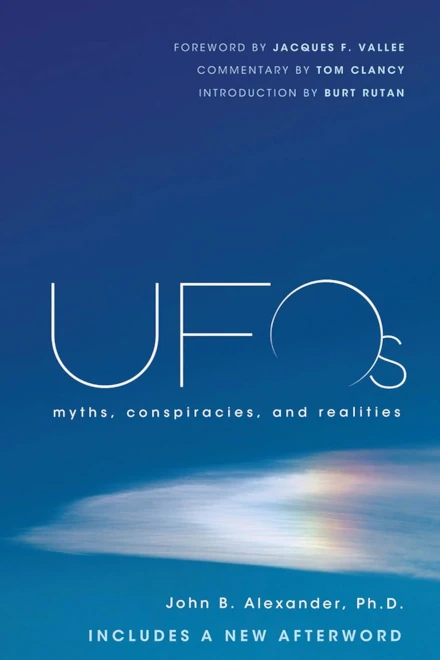
Alexander’s mainstream cultural visibility increased when journalist Jon Ronson’s The Men Who Stare at Goats highlighted the strange edges of military experimentation and featured Alexander as a key character. In the UFO domain, his later work includes authoring UFOs: Myths, Conspiracies, and Realities, which positioned him as an “insider voice” willing to treat classic UFO cases as worthy of study while also challenging conspiracy inflation and weak evidentiary leaps. In the post-2017 disclosure era, Alexander’s name continues to recur as commentators revisit older networks and meetings to argue either continuity or discontinuity with modern UAP programs.
Major Contributions
- Non-lethal weapons advocacy: helped legitimize non-lethal capability as a serious military modernization domain rather than a novelty.
- Boundary-zone institutional memory: served as a connector and narrator for how unconventional ideas can move through defense and intelligence-adjacent ecosystems.
- UFO framing as a complex systems problem: articulated a model of the UFO issue as layered, messy, and resistant to single-cause explanations.
Notable Cases
“The Men Who Stare at Goats” milieu: Alexander is strongly associated with the public mythos surrounding military psi experimentation—both in the skepticism-driven debunking cycle and in the fascination with “human potential” projects.
Classic UFO case commentary: In his book and talks, Alexander engages well-known cases and cultural touchstones (e.g., base rumors, iconic incidents) less as a single-investigation authority and more as a synthesizer who evaluates strengths, weaknesses, and narrative distortions.
Interagency “advanced physics/anomalies” discussions (1980s lore): Alexander is repeatedly cited as having organized or participated in a low-profile interagency exploration effort, which has become a recurring reference point in UAP policy arguments.
Views and Hypotheses
Alexander’s public stance typically threads a narrow line: he treats anomalous reports as potentially real and important while resisting the temptation to declare any single definitive explanation (aliens, secret U.S. craft, pure hoaxing, etc.). He emphasizes that bureaucracies generate secrecy for many reasons unrelated to aliens; that misinformation and rumor can thrive in classified contexts; and that the UFO topic is both a sociological phenomenon and (possibly) an empirical one. This combination—open to anomaly, skeptical of simplistic narratives—helped him appeal to audiences across belief spectra.
Criticism and Controversies
Alexander’s controversies largely follow from proximity to disputed domains. Skeptics criticize him for lending credibility to paranormal-adjacent military stories and for appearing within a media ecosystem that can amplify weak claims through repetition. Conversely, some true-believer audiences criticize him for “not going far enough,” viewing his caution as an attempt to domesticate or contain more radical interpretations. In UAP contexts, a recurring dispute concerns whether references to “advanced physics” interagency groups indicate genuine hidden programs or merely exploratory meetings that never produced extraordinary results.
Media and Influence
Alexander’s media influence is unusually durable because he sits at an intersection of compelling story genres: special operations mystique, Cold War weirdness, and UFO intrigue. His name appears in books, documentaries, podcasts, and policy-adjacent discourse, often as an “institutional memory” witness. His prominence in popular culture (via The Men Who Stare at Goats) also ensures continued rediscovery by new audiences.
Legacy
John B. Alexander’s legacy in ufology is that of a bridge figure. He helped normalize the idea that the UFO topic can be discussed in a serious, institution-aware way—without automatically collapsing into either pure debunking or pure conspiracy. Whether future disclosures validate any strong claims associated with the broader UAP ecosystem, Alexander’s role as an organizer, narrator, and boundary-walker has already shaped how the “UFO problem” is framed for audiences who care about defense institutions, secrecy dynamics, and the limits of public knowledge.