Introduction
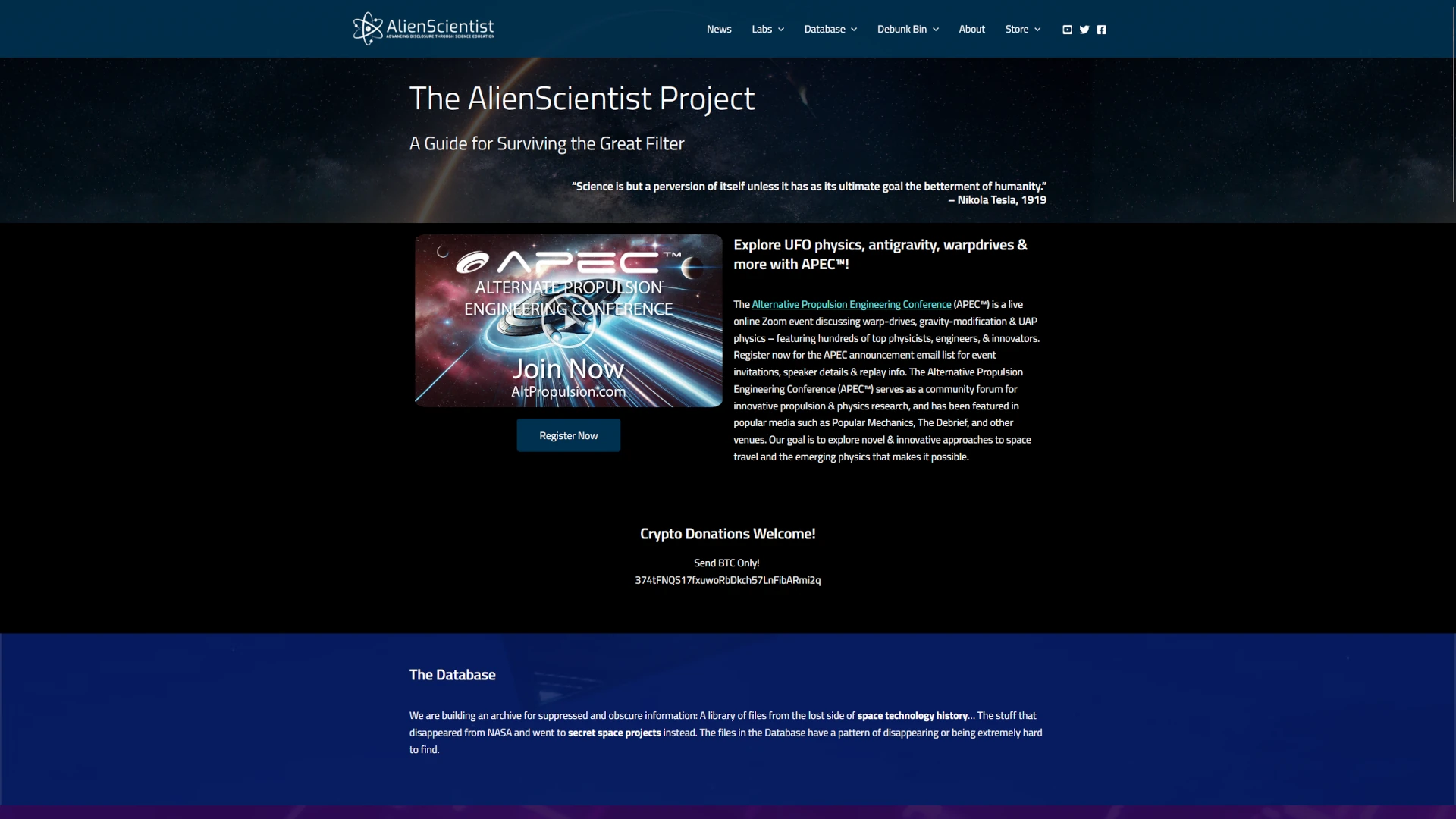
Jeremy Rys, widely known online as “AlienScientist”, is an independent researcher-commentator and media creator who operates in the overlap zone between ufology, alternative propulsion culture, and internet-native science communication. His public reputation is built less on traditional case-file field investigation and more on interpretive synthesis: taking the language of physics and engineering—materials science, electromagnetism, propulsion constraints, and institutional research pathways—and applying it to UAP narratives, “disclosure” debates, and claims of advanced or suppressed technology.
Background
Public biographical summaries describe Rys as having formal training in physics (commonly stated as a B.S. in Physics) and as having worked for years as a video producer, writer, narrator, and editor under the AlienScientist identity. The “AlienScientist” label functions as both a channel brand and a worldview signal: an attempt to approach UFO culture through an engineering/physics framing while remaining sympathetic to the possibility of extraordinary technologies.
Ufology Career
Rys’ role in ufology is primarily that of a media personality and interpretive analyst. Rather than specializing in witness interviewing, site investigations, or archival FOIA work, he tends to engage the subject as a “technology problem”: if some UAP reports are accurate, what classes of propulsion, energy storage, materials, and control systems might hypothetically produce the claimed performance? This approach places him within the “UFO physics / breakthrough propulsion” subculture, where narratives about field drives, exotic materials, and black programs are treated as the key explanatory domain.
Early Work (2008–2014)
Rys’ early public footprint is associated with establishing AlienScientist as a long-running independent platform. In this phase, the identity appears to have developed as a hybrid of skepticism toward institutional narratives and curiosity about “edge” technology claims, using online media distribution as the primary amplifier. The characteristic style that later defined his public work—long-form commentary, deep dives, and cross-domain synthesis—was forged during the broader rise of YouTube-era alternative science content.
Prominence (2015–2022)
Rys’ prominence increased as UAP discourse expanded online and podcast culture matured into a major channel for long-form “outsider” analysis. During this period, he became a recurring guest across shows that mix UFO disclosure talk with speculative engineering and institutional critique. His public identity stabilized around a set of recurring themes: advanced propulsion as the core mystery, materials as the bottleneck, and disinformation/psyops as a meta-layer shaping what the public believes it knows.
Later Work (2023–present
In the current phase, Rys functions as a networked personality within the wider UAP media ecosystem—appearing on high-visibility podcasts, publishing commentary through AlienScientist channels, and engaging “truth parsing” debates about digital misinformation, counterintelligence narratives, and the reliability of online evidence. As UAP has become more mainstream, his brand remains positioned as “pre-mainstream” interpretation: emphasizing what he views as the technical and institutional implications behind the headlines.
Major Contributions
- Propulsion-first framing of UAP: treating UAP claims as an engineering feasibility puzzle rather than solely a sociological mystery.
- Podcast-era synthesis: helping translate complex, jargon-heavy “breakthrough tech” ideas into internet-native explanatory narratives.
- Disinformation meta-narrative emphasis: repeatedly foregrounding the possibility that UAP discourse is shaped by strategic messaging, narrative control, and psychological operations.
Notable Cases
Rys is not primarily identified with one signature “investigated case.” His “cases” are typically discursive clusters: the set of widely circulated UAP claims and personalities at any given moment (government hearings, alleged exotic materials, crash-retrieval rumors, reverse-engineering lore), interpreted through a propulsion/materials lens. His notability lies in how he re-frames the subject—less “what did the witness see?” and more “what technology would have to exist if that claim were true?”
Views and Hypotheses
Rys’ public stance is generally sympathetic to the possibility of advanced technology existing beyond public acknowledgment, while also emphasizing that public narratives may be engineered or distorted. He frequently treats “exotic propulsion” as a plausible explanatory category for at least some UAP reports, and he tends to interpret the information environment—podcasts, leaks, viral clips, social platforms—as a contested arena where truth, myth, entertainment, and influence operations can blend. This produces a worldview that is simultaneously “pro-anomaly” and “highly suspicious of the narrative layer.”
Criticism and Controversies
As with many UAP media figures, criticism often focuses on epistemics: whether technical language is being used to give ambiguous claims the appearance of rigor, and whether speculative synthesis becomes indistinguishable from evidence-based inference. Supporters argue that independent voices are necessary because institutional channels filter taboo topics. Critics argue that the same independence can encourage overconfident conclusions, narrative stacking, and the amplification of unverified claims through repeated circulation rather than through validation.
Media and Influence
Rys’ influence is primarily mediated through AlienScientist-branded publishing and the long-form podcast circuit. He has appeared on prominent shows and clips discussing UAP, psyops/disinformation, and “cutting-edge engineering outside institutions.” This mode of influence is typical of modern ufology: network visibility, cross-platform clipping, and persona-driven interpretation often matter more than classic print bibliographies.
Legacy
Jeremy Rys’ emerging legacy is as a representative of the “post-2017” UAP media ecology: a figure who blends science-adjacent explanation, skepticism toward institutional narratives, and curiosity about extraordinary claims into a coherent brand. Whether his interpretations age well will depend on how future evidence reshapes the UAP conversation. Regardless, his work illustrates how contemporary ufology increasingly functions as a media-synthesis arena where engineering talk, intelligence-history talk, and online evidence culture collide.