Introduction
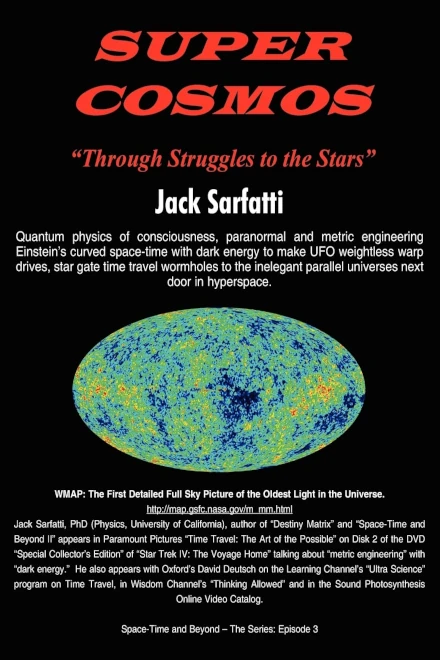
Jack Sarfatti (born 1939) is an American theoretical physicist known for his role in the California-based “Fundamental Fysiks Group” of the 1970s and for decades of highly public speculation at the intersection of quantum foundations, consciousness, and unconventional propulsion ideas. Working largely outside mainstream academic physics after early university appointments, Sarfatti became a recognizable public figure in the orbit of counterculture science, where debates about interpretation, measurement, and observer effects in quantum mechanics were frequently extended into broader metaphysical and technological claims. In later decades he also became a recurring voice in ufology-adjacent “UAP physics” discussions, asserting that some reported flight characteristics imply exotic field control or spacetime/metric engineering.
Background
Sarfatti was educated in physics through the American university system and completed doctoral work focused on gauge invariance and superfluidity. His early career included a period of conventional academic employment before he increasingly shifted toward independent work, public lecturing, and nontraditional publishing. This trajectory—academic credentialing followed by long-term activity on the margins of institutional physics—shaped his public identity: a technically literate insider-outsider who argues that key breakthroughs occur where foundational questions are treated as engineering opportunities rather than philosophical curiosities.
Ufology Career
Although not a “ufologist” in the classic sense of a case investigator, Sarfatti’s relevance to ufology stems from his sustained claim that certain UFO/UAP narratives are best interpreted through advanced physics rather than purely sociological or psychological frameworks. He has positioned himself as a translator between technical language and sensational claims, arguing that reported accelerations, silent hovering, abrupt right-angle turns, and apparent inertia-defying maneuvers point toward new kinds of field control. In this role he has influenced a subculture of “breakthrough propulsion” commentary in which UAP reports are treated as data points motivating speculative theoretical models.
Early Work (1960–1974)
Sarfatti’s early period is rooted in formal physics training and early professional appointments. During this phase he developed a reputation for intellectual ambition and a willingness to engage foundational issues that many working physicists considered interpretive or “philosophical.” By the early 1970s, he was increasingly immersed in the West Coast environment where physics conversations mixed with counterculture networks, creating the social conditions that would soon crystallize into the Fundamental Fysiks Group.
Prominence (1975–1985)
Sarfatti’s public prominence surged with the visibility of the Fundamental Fysiks Group and the publication of popular-facing work such as Space-Time and Beyond, a “cartoon guide” style book that aimed to make difficult concepts in relativity, quantum theory, and consciousness debates accessible while also encouraging expansive interpretations. In this period, Sarfatti became known less for standard journal output and more for his role as a catalyst—an organizer and provocateur who treated frontier questions as culturally and technologically consequential. His name became associated with a distinctive rhetorical style: physics as a doorway to mind–matter interaction, retrocausality, and the possibility of engineering realities that orthodox physics treated as fixed constraints.
Later Work (1986–present)
In later decades Sarfatti’s work became increasingly expressed through self-published books, online essays, interviews, and lecture-style documents. He continued to emphasize quantum interpretation questions while moving more explicitly into claims about advanced propulsion and “metric engineering,” framing them as extensions of general relativity, quantum vacuum ideas, and novel materials concepts. As public UAP discourse re-emerged in waves, Sarfatti positioned himself as a physics-forward commentator, asserting that the technical anomalies reported in certain narratives are consistent with field-based inertia manipulation, spacetime curvature control, or other mechanisms that would appear “laws-of-physics breaking” to conventional engineering.
Major Contributions
- Counterculture quantum foundations influence: helped sustain and popularize interpretive debates about quantum mechanics during an era when foundational questions were often treated as fringe.
- Quantum–consciousness speculation as public narrative: advanced a long-running thesis that observer/measurement issues imply a deeper role for mind-like variables in physical theory.
- UAP/metric-engineering advocacy: became a persistent public voice arguing that certain UAP reports motivate serious attention to exotic propulsion and spacetime engineering concepts.
Notable Cases
Sarfatti is not chiefly associated with a single “case file” in the manner of MUFON-style investigators. Instead, he is notable for repeatedly engaging with high-profile UAP narratives as physics prompts—treating clusters of claims (extreme acceleration, low acoustic signature, transmedium travel, instantaneous directional changes) as a phenomenological package requiring nonstandard theoretical tools. His “cases” are therefore better understood as recurring reference sets: whatever public incidents are culturally dominant at a given moment, reframed through his preferred lens of field control and metric manipulation.
Views and Hypotheses
Sarfatti’s worldview blends several recurring themes: (1) quantum measurement and observer questions are central and not optional; (2) consciousness is plausibly a physical variable with causal efficacy; (3) time symmetry, retrocausality, or advanced boundary-condition thinking may be required for a deeper theory; and (4) general relativity should be treated as an engineering playground rather than a purely descriptive framework—implying that “warp-like” or inertia-modifying effects could be technologically realizable under the right material/field conditions. In ufology-adjacent settings he often expresses these hypotheses in pragmatic terms: if advanced craft exist, their performance might be explained by controllable spacetime geometry, field-induced inertia modification, or vacuum-structure engineering rather than by reaction mass propulsion.
Criticism and Controversies
Sarfatti has long been polarizing. Supporters view him as a rare figure willing to think beyond professional conformism and to connect foundational puzzles to technological possibilities. Critics argue that his public claims frequently outrun evidentiary standards, that many proposals are under-specified or not credibly demonstrated, and that blending consciousness speculation with propulsion talk invites category errors and rhetorical overreach. Within mainstream physics culture, he is often treated as an outsider whose influence is more cultural than scientific, while within ufology and “breakthrough” communities he is alternately celebrated as an insider validator or criticized for speculative volatility and shifting emphases.
Media and Influence
Sarfatti’s influence is disproportionately mediated through interviews, online essays, and community cross-pollination rather than peer-reviewed publication impact. He has served as a recognizable node connecting (a) quantum-foundations counterculture history, (b) consciousness-and-physics speculation, and (c) modern UAP “physics of the phenomenon” subcultures. His name remains recurrent in discussions that treat UFO/UAP narratives as an impetus for frontier theoretical exploration.
Legacy
Sarfatti’s legacy is best summarized as that of a provocateur and bridge-figure. Historically, he is a vivid representative of the era when quantum foundations re-entered popular consciousness through counterculture channels. In contemporary “UFO physics” discourse, he functions as an engine of speculative synthesis, continually proposing how reported anomalies might be reconciled with an expanded physics toolkit. Whether his technical conjectures endure or not, his long-running role in shaping the language and ambition of fringe-adjacent physics conversations is durable.