Introduction
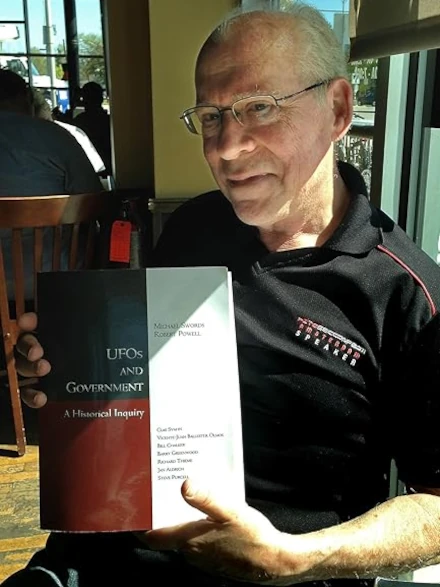
Michael D. Swords is an American UFO historian and scholarly organizer known for meticulous work on the documentary history of official UFO investigations. In a field often dominated by sensational narratives, Swords’ influence derives from discipline: reconstructing what agencies actually did, how conclusions were formed, and which documents demonstrate uncertainty, bias, or internal disagreement. He is frequently associated with efforts to present ufology as a serious historical inquiry into state behavior, scientific norms, and the management of anomalous reports.
Background
Swords’ professional background and scholarly temperament shaped his approach to ufology. Rather than treating UFO cases as isolated mysteries, he emphasizes institutions—how military and scientific bodies respond to ambiguity. This requires archival literacy: knowing which documents exist, what they mean, and how later retellings diverge from contemporaneous records.
Ufology Career
Swords’ ufology career is rooted in research, editing, and organizational leadership. He has been associated with scholarly UFO journals and study groups that prioritize careful sourcing and peer dialogue. His work frequently centers on the early U.S. Air Force projects and the evolution of “official skepticism” as both scientific posture and bureaucratic strategy.
Early Work (1975-1990)
Swords emerged during a period when researchers increasingly sought declassified documents and first-generation witness testimony from military programs. In this era, his efforts focused on building a reliable historical spine for ufology—reducing dependence on rumor and emphasizing what can be shown through records.
Prominence (1991-2015)
As major document collections expanded and public interest revived, Swords became widely cited for his ability to contextualize documents without overreading them. He contributed to large-scale syntheses that became standard references for understanding how governments and scientists managed the UFO problem as an administrative and reputational issue.
Later Work (2016-2025
In the modern UAP era, Swords’ historical approach gained renewed relevance: contemporary debates about transparency are often framed against earlier eras of official denial or closure. Swords’ work provides continuity—showing which patterns are new and which repeat older institutional dynamics.
Major Contributions
- Strengthened ufology’s documentary foundation through rigorous historical method.
- Helped produce reference works on UFOs and government that organize vast archives for public use.
- Modeled a non-sensational style that still takes anomalies seriously.
Notable Cases
Swords is most associated with program histories rather than single iconic sightings. His “cases” include:
- Project Sign, Grudge, and Blue Book internal dynamics.
- How official conclusions were communicated versus how records show ambiguity.
Views and Hypotheses
Swords generally argues that the historical record shows sustained institutional uncertainty about a minority of cases and that “closure” narratives often oversimplify. He tends to avoid hard claims about ultimate origin, emphasizing instead that the history of the problem—how institutions behaved—is itself significant evidence.
Criticism and Controversies
Proponents sometimes wish for stronger “ET” conclusions; skeptics sometimes argue that unresolved cases merely reflect incomplete data. Swords’ stance remains conservative: do not outrun the documents, but do not pretend the documents say less than they do.
Media and Influence
His influence is strongest in serious UFO study circles, documentary projects that need historical grounding, and authors who require reliable context for government-era archives.
Legacy
Swords’ legacy is that of a historian who helped move ufology from anecdote-driven culture toward archival accountability—making it harder for myths to substitute for records.