Introduction
Scott Ramsey is an American UFO researcher and author best known as the leading contemporary investigator and public advocate for the alleged 1948 Aztec, New Mexico flying saucer crash/recovery story. While the Aztec narrative circulated widely in the early “flying saucer” era and was later treated by many writers as a classic example of UFO-era fraud, Ramsey helped reintroduce the case to modern audiences by arguing that it contains a core of suppressed truth obscured by a deliberate disinformation environment and subsequent ridicule. His work has become inseparable from the modern Aztec debate: for supporters, he is the researcher who brought structure and persistence to a neglected story; for critics, he is the principal figure in a contemporary revival of a historically discredited claim.
Background
Ramsey’s professional background is rooted outside academic ufology, with a career in the private sector and a long-standing personal interest in anomalous aerial narratives and their historical treatment. He is often described as having approached the Aztec story as a long-term project—less as a hobbyist’s curiosity and more as an investigative endeavor involving repeated travel, relationship-building with local sources, and the slow accumulation of documents and testimony. His public bio frequently emphasizes methodical persistence: returning to the Four Corners region, tracking down witnesses and family members, and comparing retellings against regional lore, newspaper traces, and the shifting mythology of UFO crash stories.
Ufology Career
Ramsey’s ufology career is defined by specialization. Rather than being a generalist investigator filing cases across many categories, he became identified with a single contested event and its surrounding ecosystem of claims—crash/recovery logistics, alleged bodies, military involvement, secrecy mechanisms, and the role of early UFO-era promoters. This specialization gave him authority among Aztec proponents, while also making his reputation dependent on whether the Aztec story is ultimately understood as historic fraud or suppressed incident.
He also represents a modern pattern in ufology: the “case advocate” who simultaneously investigates and curates public perception through books, radio, festivals, and documentary appearances. In this model, the investigator is both archivist and narrator—responsible not only for gathering material but also for sustaining a coherent public narrative around it.
Early Work (1988-2009)
Ramsey’s involvement with the Aztec case is commonly dated to the late 1980s, when he first encountered the story and began pursuing it as a serious line of inquiry. This early period is characterized by the creation of a case archive: collecting older publications that shaped the Aztec legend, locating individuals connected to the story by geography or family memory, and repeatedly visiting the purported site region to reconcile local oral histories with the canonical “Aztec crash” storyline.
Because the Aztec account sits at the intersection of early saucer-era sensationalism and later crash-retrieval mythology, Ramsey’s early work also required distinguishing between layers of narrative: what was said when, by whom, and under what incentives. In practice, this meant treating the Aztec story as a living palimpsest—rewritten by promoters, skeptics, and later UFO writers who folded it into broader “retrieval” lore.
Prominence (2010-2016)
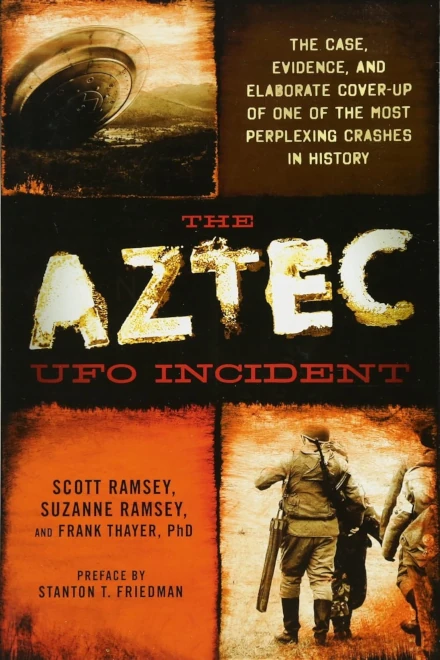
Ramsey’s prominence increased sharply with the publication and promotion of The Aztec UFO Incident (co-authored with Suzanne Ramsey and Frank Thayer). The book’s strategy was to reposition Aztec not as a simplistic “saucer swindle,” but as a case with numerous anomalies in testimony, geography, and document trails that—according to the authors—warrant renewed consideration. This period also marked Ramsey’s transition into a widely booked speaker and interview guest, where he presented the Aztec case as a serious contender in the crash-recovery canon.
His public messaging in this era typically emphasized three themes: (1) the depth of his long-term research effort; (2) the claim that dismissals often rely on caricatures of the story rather than the most detailed modern reconstruction; and (3) the idea that early fraud elements do not necessarily preclude a real event being exploited, distorted, or weaponized for profit and cover.
Later Work (2017-2025
In later work, Ramsey continued refining the Aztec narrative through ongoing interviews, conference appearances, and media projects. He became a recurring figure in “crash retrieval” discourse, where Aztec is frequently described as a precursor to later, more famous alleged recoveries. This stage is defined less by new headline revelations and more by consolidation: maintaining a central repository of claims, responding to criticism, and expanding reach to new audiences via podcasts, streaming content, and UFO festivals.
Ramsey’s later influence has also been shaped by the broader cultural shift toward “disclosure” conversations. In an environment where audiences are primed to consider hidden programs and withheld knowledge, Aztec can be reinterpreted as part of a longer continuity—an early node in an alleged retrieval timeline rather than a standalone story from the 1940s.
Major Contributions
- Aztec case revival: Brought sustained attention back to an older crash narrative that had largely fallen out of mainstream UFO conversation except as a cautionary hoax tale.
- Long-horizon case specialization: Demonstrated the “single-case” model of ufology, where deep familiarity and repeated fieldwork become the core product.
- Public-facing archive building: Helped assemble and circulate a modern compilation of testimony, site context, and interpretive frameworks that now dominate pro-Aztec presentations.
Notable Cases
The Aztec UFO Incident (1948): Ramsey’s signature subject—an alleged crash or forced landing near Aztec, New Mexico, followed by military recovery and long-term secrecy. The story’s notability rests on its early publication history, its later treatment as fraud, and its recurring reappearance in “retrieval” lore. Ramsey’s work positions the incident as a complex case with unresolved contradictions rather than a settled hoax narrative.
Views and Hypotheses
Ramsey’s interpretive stance treats the Aztec narrative as potentially rooted in a real event that was later distorted by profiteers, rumor economies, and the incentives of early saucer-era sensationalism. He tends to emphasize that “hoax exposure” does not necessarily close every question if later testimony, geographic consistency claims, or unexplained document trails suggest deeper layers. In framing Aztec, Ramsey often operates within the crash-retrieval paradigm: the assumption that some governments may have recovered unknown craft and managed the story through denial, ridicule, and selective disclosure.
Criticism and Controversies
Ramsey’s work attracts criticism primarily because the Aztec story has a long-established reputation as a classic UFO-era swindle, with early promoters tied to fraud narratives and sensational publication patterns. Critics argue that later reconstructions rely heavily on retrospective testimony, narrative interpolation, and ambiguous documents that do not meet strong evidentiary standards for extraordinary claims. They also contend that reviving Aztec can blur lines between historical analysis and advocacy, especially when a case becomes the cornerstone of a public identity.
Supporters counter that controversial cases are precisely where sustained investigation matters, and that dismissal-by-label (“it’s a hoax”) can short-circuit a careful review of what is actually being claimed in modern reconstructions. The controversy therefore remains structural: Aztec functions as a stress-test for how ufology handles early-era sensationalism, testimony reliability, and the difference between disproof of particular claims and closure of an entire narrative ecosystem.
Media and Influence
Ramsey has been influential through interviews, festival appearances, and documentary-style discussions that present Aztec as a major historical retrieval claim. In contemporary UFO media, he is often treated as the “Aztec specialist,” and his framing strongly shapes how audiences encounter the case. His media presence has helped keep Aztec circulating as a live controversy rather than a historical footnote.
Legacy
Scott Ramsey’s legacy in ufology is the modern resurrection and sustained stewardship of the Aztec crash narrative. Whether future historians treat Aztec as definitively fraudulent or as a case with unresolved core elements, Ramsey’s work has ensured that the story remains part of the contemporary crash-retrieval conversation—and that any serious discussion of Aztec must grapple with the modern reconstruction he helped build.