Introduction
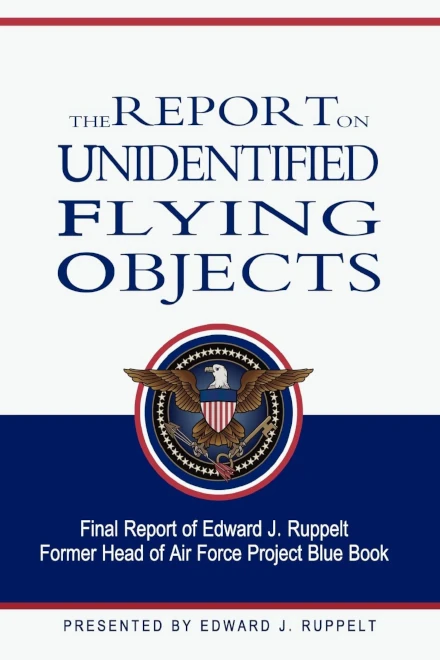
Edward J. Ruppelt was a U.S. Air Force officer best known for directing Project Blue Book and for authoring The Report on Unidentified Flying Objects (1956). In ufology, Ruppelt occupies a unique position: he is neither a later-era speculative writer nor a purely dismissive official spokesperson. Instead, he documented a messy institutional reality—waves of reports, uneven investigation quality, internal disagreement, and the tension between public reassurance and genuine uncertainty.
Background
Ruppelt’s Air Force career placed him inside a bureaucracy grappling with public fascination and military concern. The early Cold War environment shaped the UFO issue as both an intelligence question (What is in the sky?) and a communications problem (How do we respond without causing panic or revealing capabilities?).
Ufology Career
Ruppelt’s ufology career was primarily administrative and documentary: he managed case intake and investigation during a period when UFO reporting spiked, and later produced a book that became a foundational text. His significance stems from how often his account is used as a “primary-ish” narrative of official UFO investigation before the subject became fully politicized in modern disclosure culture.
Early Work (Year–Year)
Ruppelt’s early work in UFO history centers on his Blue Book leadership. He advocated more systematic handling of cases, including standardized evaluation and clearer categories. He is often credited with promoting “UFO” as a more neutral term than “flying saucer,” reflecting an institutional preference to avoid implying conclusions in the label.
Prominence (Year–Year)
Ruppelt’s prominence in ufology rose sharply after publication of his book, which many readers treated as unusually candid for an insider. Because it described real confusion—cases that seemed strong, internal disagreement, and the pressure of headlines—both believers and skeptics found usable material: believers cite uncertainty and anomalous residues; skeptics cite his emphasis on lack of proof and on misidentifications.
Later Work (Year–Year)
After Blue Book, Ruppelt’s later role in ufology is largely posthumous through his text. His narrative has been repeatedly reinterpreted as new waves of UFO interest revived old questions about what Blue Book truly represented: a genuine investigation, a public-relations shield, or an evolving mixture of both.
Major Contributions
- Institutional attempt to systematize Air Force UFO case handling during a peak reporting era.
- Authorship of a foundational insider account that continues to anchor official-history debates.
- Helped establish terminology and administrative framing that shaped later UFO programs.
Notable Cases
Ruppelt’s work intersects with multiple early-era “classic” cases and with the broader waves that triggered high-level review (including the environment that produced the Robertson Panel). His legacy is case-ecosystem rather than a single signature sighting.
Views and Hypotheses
Ruppelt’s views are often characterized as pragmatic: he acknowledged that many reports had conventional explanations and emphasized the lack of definitive proof (“hardware”), while also suggesting that a small residue of cases remained puzzling and that institutional conclusions were not always unanimous behind the scenes.
Criticism and Controversies
Believers criticize Blue Book-era investigation as biased toward dismissal and argue that Ruppelt’s account hints at deeper suppressed conclusions. Skeptics counter that his emphasis on uncertainty is often selectively quoted and that his narrative shows the opposite: how difficult it was to sustain exotic conclusions without physical evidence.
Media and Influence
Ruppelt’s book is one of the most cited texts in UFO literature and documentary scripting about the early U.S. Air Force era. His insider status gives his narrative enduring weight even when readers disagree on interpretation.
Legacy
Ruppelt’s legacy is foundational: he remains one of the primary “official-era voices” through whom later generations attempt to understand what the U.S. military believed, how it investigated, and why the UFO subject became a permanent fixture of modern mystery culture.