An Encyclopedia and Go to Source for All Things UAP

UAP Personalities

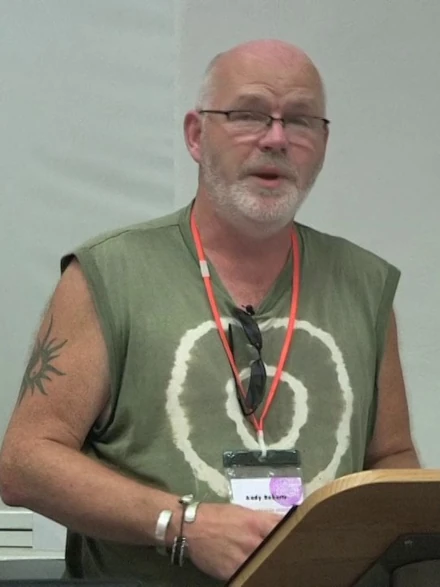
Roberts, Andy

Roberts, Andy

TL;DR Claim(s) to Fame

  • UK UFO folklore researcher known for culturally grounded re-interpretations
  • Argues many “classic cases” grow through narrative drift and community incentives
  • Bridges ufology with Fortean/psychedelic/media-history commentary
  • Prominent voice for “UFOs as folklore” and skepticism toward simplistic ET framings

Introduction

Andy Roberts is a British author and researcher who approaches ufology primarily as folklore, media history, and social psychology rather than as a straightforward question of extraterrestrial technology. In the UK scene, Roberts is known for analyzing how famous cases gain authority, how witness narratives evolve, and how the UFO subject functions as a cultural language for uncertainty, experience, and belief. His work is often read as an internal critique of ufology’s tendency to canonize stories without continuously re-testing their foundations.

Background

Roberts’ broader Fortean interests—ranging beyond UFOs into other cultural and anomalous subjects—inform his method: he treats “weird events” as stories that move through communities, changing as they move. This background makes him attentive to sources, publication chains, and the role of magazines, conferences, and television in manufacturing “classic” status.

Ufology Career

Roberts’ ufology career is rooted in commentary, authorship, and cultural analysis. He is less concerned with proving an ultimate cause than with understanding how ufology works as a belief system and as a narrative economy. This places him in a tradition that overlaps with “psychosocial” approaches—views that UFO experiences are real as experiences but culturally shaped in their interpretation.

Early Work (Year–Year)

Roberts developed visibility through writing and participation in Fortean/UFO circuits, building a reputation for challenging received wisdom. Early work often focused on how cases are constructed: what the first report said, what later books added, and which elements were introduced by investigators rather than witnesses.

Prominence (Year–Year)

Roberts’ prominence increased as ufology entered an era of rapid online amplification, where the “story-life” of cases accelerated. His approach—trace the narrative genealogy—became more valuable as communities circulated claims detached from original documentation. In this period, Roberts became known as a critic of ufology’s internal mythmaking.

Later Work (Year–Year)

Later work continues to emphasize source criticism and cultural framing. Roberts frequently highlights how ufology can mirror other subcultures: heroes, villains, origin myths, schisms, and reputational economies. His analysis often implies that the UFO phenomenon cannot be separated from the human systems that report and narrate it.

Major Contributions

  • Strengthened “UFO as folklore” and narrative-genealogy approaches in UK ufology.
  • Public critique of case canonization and investigator-driven embellishment.
  • Expanded ufology discussion into media studies, subculture dynamics, and myth formation.

Notable Cases

Roberts is associated with reappraisals of British cases and with meta-analysis of how specific incidents became famous. Rather than owning a single signature investigation, he is known for “deconstructive” work across multiple narratives, often targeting cases that became cultural keystones.

Views and Hypotheses

Roberts’ views typically resist binary conclusions (aliens vs. hoax). He treats ufology as an arena where ambiguous stimuli, personal experience, and cultural templates interact. His hypotheses often privilege social and psychological mechanisms—memory, expectation, narrative reward—without denying that some observations may remain unresolved.

Criticism and Controversies

Believer-oriented ufologists sometimes argue Roberts is too dismissive and that cultural analysis becomes a way to avoid confronting genuinely anomalous data. Supporters argue his approach is necessary precisely because ufology’s documentation is often weak and its narratives self-reinforcing.

Media and Influence

Roberts is influential through writing, interviews, and his role as a commentator who provides a vocabulary for “how ufology works” rather than “what UFOs are.” This makes him a key figure for readers who want an encyclopedic understanding of ufology as a movement and cultural phenomenon.

Legacy

Roberts’ legacy is as a modern British “ufology critic from within”: a figure who treats the subject as a cultural system requiring the same skeptical tools used in historiography—source criticism, narrative genealogy, and institutional analysis.

Roberts, Andy

robert.francis.jr 1 Comment(s)
This is a topic for discussing Andy Roberts to improve his Article and add any missing interviews, podcasts and documentaries in the Media section.
Quote