An Encyclopedia and Go to Source for All Things UAP

UAP Personalities

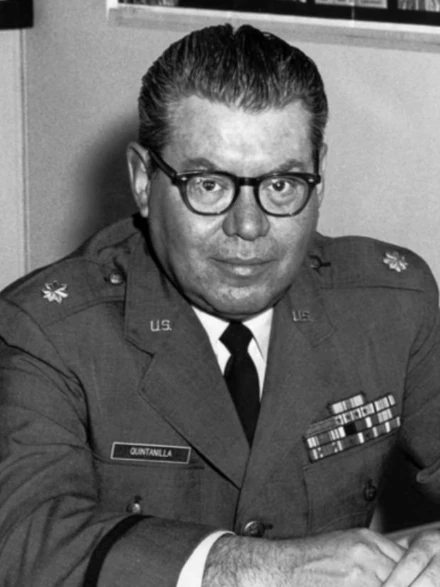
Quintanilla, Hector

TL;DR Claim(s) to Fame

  • Led Project Blue Book as its final chief, managing the USAF’s official UFO casework.
  • Associated with a skeptical posture and “explanation-driven” case closures in Blue Book’s late phase.
  • Frequent foil in post-Blue Book criticism about alleged minimization of “unknowns.”
  • Linked to institutional writing/briefing on UFO investigations and their limits.

Introduction

Hector Quintanilla Jr. was a United States Air Force officer best known as the final head of Project Blue Book, the Air Force’s official, long-running program for receiving, evaluating, and cataloging reports of unidentified flying objects. His tenure coincided with Blue Book’s terminal period, when public pressure, internal skepticism, and interagency interests converged to narrow the program’s scope and harden its explanatory posture.

Background

Born in Mexico and raised in the United States, Quintanilla’s early life narrative is often presented as an immigrant success story culminating in military service and technical responsibility. In the Air Force environment, UFO casework was handled as a mixture of public-relations management, air-defense hygiene, and scientific consultation rather than as an open-ended search for extraterrestrial visitation.

Ufology Career

Quintanilla’s “ufology career” is inseparable from the institutional structure of Blue Book. Unlike civilian investigators, he did not build a private network of field researchers or develop an independent theory of UFO origins; his work was administrative and adjudicative—reviewing reports, commissioning analyses, and issuing determinations designed to satisfy Air Force priorities.

Early Work (1950s-1963)

Before his leadership role, UFO investigation inside the Air Force had already accumulated layers of protocol: screening reports for defense relevance, consulting scientific advisors, and preparing public-facing summaries. By the time Quintanilla rose to prominence, the program’s default aim was to reduce uncertainty, prevent panic, and minimize reputational risk rather than to cultivate “mystery.”

Prominence (1963-1969)

Quintanilla became the public and bureaucratic face of Blue Book during an era of heightened media attention and activist critique. Within ufology circles, he is frequently characterized as emblematic of official skepticism—an approach that, to believers, appeared as systematic debunking, and to institutional defenders, appeared as prudent management of low-quality, noise-heavy reporting streams.

Later Work (1969-1998

After Blue Book’s closure in 1969, Quintanilla’s direct role in UFO adjudication ended, but his name persisted in debates about what the Air Force did or did not know. Later retellings often positioned him within broader “cover-up” narratives, while institutional histories treated his period as the final stabilization and sunset phase of an aging program.

Major Contributions

  • Operationalized late-stage Blue Book workflows: intake, triage, analysis, and closure.
  • Helped define the final “tone” of official UFO handling—skeptical, conservative, and PR-aware.
  • Contributed to the archival legacy of Blue Book case files and determinations.

Notable Cases

As Blue Book chief, Quintanilla’s influence extended across many cases rather than a single signature event. His era overlaps with recurring flashpoints—radar-visual reports, mass-sighting claims, and cases promoted by civilian groups as “best evidence.” In the ufological literature, his decisions are often cited as examples of premature conventional explanations, though defenders argue those explanations reflected the evidentiary quality available to the Air Force.

Views and Hypotheses

Quintanilla is most consistently associated with a pragmatic institutional view: UFO reports are frequently misidentifications, psychological misperceptions, hoaxes, or poorly documented anomalies; where uncertainty remains, it does not automatically justify extraordinary conclusions. This stance aligned with the Air Force’s preference to avoid validating speculative interpretations absent compelling physical evidence.

Criticism and Controversies

Critics within civilian ufology argued that Blue Book under Quintanilla favored “closure” over open inquiry, sometimes producing explanations that did not convincingly account for witness detail or instrumentation. These critiques intensified because Blue Book’s conclusions carried governmental authority, shaping public perception and marginalizing dissenting interpretations.

Media and Influence

Quintanilla remains a major historical character in the meta-narrative of “official UFO history”—often referenced in documentaries, retrospectives, and debates about government transparency. His name functions as shorthand for the late-Blue-Book posture: an emphasis on reputational containment and conventional explanation.

Legacy

Quintanilla’s legacy is primarily institutional: he represents the final managerial logic of Project Blue Book and the transition from overt, centralized UFO investigation to a post-Blue-Book era characterized by dispersed reporting channels, periodic secrecy controversies, and recurrent calls for renewed official study.

Books

Non-Fiction

The Investigation of UFO's
https://www.amazon.com/dp/B00AUXS8RE/

Quintanilla, Hector

robert.francis.jr 1 Comment(s)
This is a topic for discussing Hector Quintanilla to improve his Article and add any missing interviews, podcasts and documentaries in the Media section.
Quote