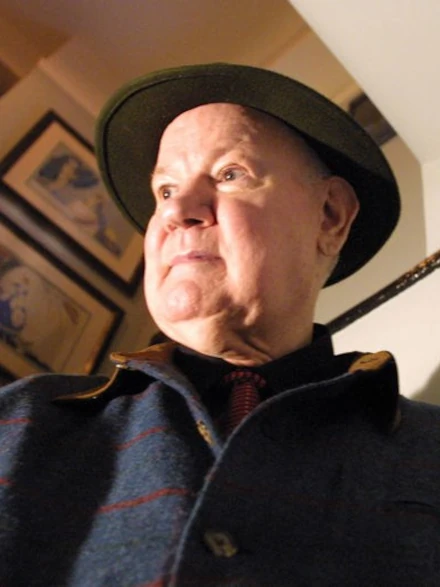
Introduction
John Keel was an American author and investigator best known for reshaping ufology’s interpretive boundaries by arguing that UFOs are inseparable from a broader field of anomalous phenomena. Rather than treating UFOs as simply extraterrestrial spacecraft, Keel emphasized “high strangeness”: apparitions, poltergeist-like events, synchronicities, prophetic experiences, and the sense of an intelligence that manipulates perception and belief. His work remains foundational for “trickster” and “ultraterrestrial” schools of thought.
Background
Keel’s career developed through writing, travel, and engagement with the anomalous-phenomena subculture. His style combined reportage with synthesis, creating narrative case histories that foregrounded the emotional and symbolic intensity of events alongside the factual claims.
Ufology Career
Keel’s ufology career spans investigation, writing, and theory-building. He pursued waves of reports and treated clusters—periods where multiple strange events co-occur—as especially significant. His key contribution was interpretive: the argument that the phenomenon appears to stage-manage itself, producing absurdity, ambiguity, and mythic resonance.
Early Work (1957-1965)
In early work, Keel engaged with contactee culture and early UFO waves, developing skepticism toward simplistic ET narratives and toward the reliability of “messages” and alleged communications. He became increasingly interested in patterns of deception and the psychological texture of encounters.
Prominence (1966-1976)
Keel’s prominence grew with his investigation and chronicling of the Point Pleasant era and related phenomena, which became emblematic of ufology’s overlap with folklore and the paranormal. His books from this period solidified his reputation as a leading “high strangeness” interpreter.
Later Work (1977-2009)
Later work continued to elaborate ultraterrestrial and trickster-like frameworks. Keel remained influential through reprints and through the growing subculture that views UFOs as a consciousness-linked phenomenon rather than a purely technological one.
Major Contributions
- High-strangeness integration: Connected UFOs to broader paranormal clusters and symbolic effects.
- Ultraterrestrial hypothesis: Advanced models where “the phenomenon” is indigenous to reality and manipulative of belief.
- Wave and cluster emphasis: Highlighted temporal-spatial concentrations as analytically important.
Notable Cases
Point Pleasant / Mothman era: Keel’s chronicling of this period helped define it as a paradigmatic case study of UFO-paranormal overlap, with reports extending beyond lights in the sky to ominous experiences, synchronicities, and folklore-like encounters.
Views and Hypotheses
Keel argued that the phenomenon behaves like a trickster intelligence: it produces contradictory “messages,” theatrical displays, and culturally adaptive imagery. He treated contact narratives as psychologically potent but epistemically unstable, warning that the phenomenon may be designed to confuse and to generate myth rather than to reveal straightforward facts.
Criticism and Controversies
Critics argue that Keel’s synthesis is too elastic, making it difficult to test or falsify. Skeptics see his work as folklore building; literalist ufologists see it as an unnecessary detour from physical evidence. Supporters argue that conventional models fail precisely because the phenomenon itself is structured to evade simple explanation.
Media and Influence
Keel’s influence extends across books, documentaries, and modern podcasts, especially within “woo”/consciousness-oriented ufology. Many contemporary “the phenomenon is stranger than ET” narratives trace directly to his framing and vocabulary.
Legacy
Keel remains one of ufology’s most influential theorists of ambiguity—a writer whose work helped establish the enduring idea that UFOs are part of a broader, psychologically and culturally entangled mystery.