Introduction
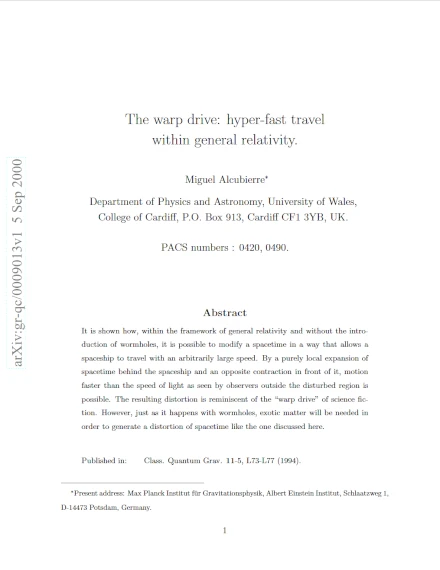
The Alcubierre drive is a hypothetical faster-than-light (FTL) travel concept derived from a specific spacetime metric in general relativity (GR) introduced in 1994 by Miguel Alcubierre. Rather than accelerating a spacecraft through space beyond light speed, the Alcubierre metric describes a compact region of curved spacetime—often called a “warp bubble”—that moves by expanding spacetime behind it and contracting spacetime in front of it. Inside the bubble, observers can remain locally at rest (or moving slowly) relative to their immediate surroundings while the bubble itself translates through the external universe at an arbitrarily high coordinate speed as measured by distant observers.
Background
In GR, the geometry of spacetime is not fixed: it is determined by the distribution of energy and momentum via Einstein’s field equations. Because the equations admit a broad landscape of mathematically consistent solutions (“metrics”), it is possible to write down spacetimes with counterintuitive global properties—wormholes, closed timelike curves, and cosmological expansion that separates distant galaxies faster than light without violating special relativity locally.
The Alcubierre drive belongs to a class of ideas sometimes called metric engineering: rather than relying on reaction mass (as rockets do), one specifies a desired spacetime geometry and then asks what kind of stress–energy tensor would be required to generate it. The important distinction is that mathematical permissibility does not imply physical constructibility. A metric can satisfy Einstein’s equations while still requiring matter distributions that appear impossible or forbidden by known physics.
Ufology Career
Although conceived within mainstream GR, the Alcubierre drive became one of the most frequently cited “respectable physics” concepts in UAP and ufology circles. It is often used as a catch-all explanation for reported flight characteristics—instant acceleration, right-angle turns, silent hovering, transmedium motion, and lack of aerodynamic signatures. In this context, “warp drive” is frequently conflated with inertial control (reducing g-forces), field propulsion (no reaction mass), and literal interstellar FTL, even though these are distinct technical problems. The Alcubierre metric, specifically, addresses effective superluminal transport by geometry—not evidence of any demonstrated engineering pathway.
Early Work (1994–1998)
Alcubierre’s 1994 paper introduced a concrete warp-bubble metric with a freely choosable “shape function” that defines a compact region where the geometry differs from flat spacetime. The ship is placed inside this region. The bubble’s center follows a worldline whose coordinate speed can be set arbitrarily, producing effective FTL relative to distant observers.
Very quickly, follow-on analyses focused on what stress–energy would be required. These calculations showed that the Alcubierre bubble typically needs negative energy density in portions of the bubble wall—i.e., violations of standard energy conditions (notably the weak and null energy conditions). This “exotic matter” requirement became the dominant obstacle: it is not known how to produce and stably arrange macroscopic negative energy at the needed scales.
Prominence (1999–2012)
As the concept gained visibility, several lines of critique and refinement emerged:
- Energy scale objections: Early estimates suggested enormous energy requirements—often described in mass-energy equivalents—depending on bubble size, wall thickness, and speed. Even when later work reduced naive estimates, the required magnitudes remained far beyond plausible engineering.
- Horizon formation and control: For superluminal bubble motion, horizon-like structures can appear at the bubble boundary. This implies severe operational issues: regions of the bubble may be causally disconnected, making it difficult or impossible for the crew to control the bubble’s front edge or to send signals forward through the bubble wall.
- Creation/initial-value problem: Even if a warp metric exists as a solution, producing it from ordinary initial conditions using causal processes is another matter. Many analyses indicate that forming a superluminal bubble may be impossible without already having exotic configurations or violating causality in the setup process.
- Quantum backreaction and instability: Semiclassical arguments suggest that the horizons and extreme gradients would generate large quantum effects (particle creation, divergent stress–energy) that could destabilize the bubble or bathe it in destructive radiation.
During this era, a recurring public misunderstanding solidified: that “a GR solution exists” means “physics permits it” and therefore “engineering is the only remaining step.” In professional relativity work, the stress–energy requirements and stability constraints are central; existence of a metric is only the beginning.
Later Work (2013–present)
In the 2010s and 2020s, the Alcubierre drive remained a reference point while the field diversified into related constructions and reframings:
- Metric variants and shaping strategies: Proposals such as Natário-type warp drives (altering the expansion/contraction picture), and geometric tricks like “volume reduction” (e.g., Van den Broeck–style ideas) attempt to reduce the amount of exotic matter by changing bubble geometry. These often shift the problem to extreme curvature gradients, microscopic structures, or other non-engineerable features.
- “Physical warp drives” classification: Some work reframes warp metrics by emphasizing the matter model required, categorizing which spacetimes could be sourced by physically plausible stress configurations and which demand fundamentally exotic matter.
- Positive-energy and soliton proposals: Newer papers propose warp-like soliton solutions claimed to avoid negative energy under certain conditions. These do not automatically solve the broader challenges—formation, stability, control, and compatibility with stronger energy conditions or quantum inequalities.
- Institutional-adjacent narratives: NASA-adjacent presentations about “warp field mechanics” and interferometer test beds contributed to public interest, but did not establish that a practical warp drive is near-term or that the exotic-matter barrier has been overcome.
As a result, the Alcubierre drive today is often treated less as a near-term engineering concept and more as a canonical thought experiment that probes the boundaries between GR, quantum field theory, and plausible stress–energy.
Major Contributions
- Concrete warp-bubble metric: Provided an explicit mathematical template for effective superluminal motion without local superluminal travel, creating a focal point for “metric engineering.”
- Feasibility stress-test: Forced explicit accounting of energy conditions, exotic matter, and the metric–source relationship, clarifying that many elegant geometries require unphysical sources.
- Research catalyst: Triggered a large literature on energy-condition violations, horizon behavior, and semiclassical instabilities that extends beyond warp drives to wormholes and other exotic spacetimes.
Notable Cases
The Alcubierre drive is best characterized by “notable episodes” in theory and public discourse:
- 1994 introduction: The original warp metric becomes the standard reference.
- Energy-condition analyses: Establishment of negative-energy requirements as the central obstacle.
- Horizon/control problem emphasis: Recognition that superluminal bubbles introduce causal barriers and operational paradoxes.
- Public rebranding cycles: Periodic surges of attention (popular media, institute talks) framing “warp drive progress,” followed by clarifications that core physics constraints remain.
Views and Hypotheses
Within a conservative scientific perspective, the Alcubierre drive is interpreted as a legitimate GR solution that is not known to be physically realizable given the need for exotic stress–energy and the likelihood of destabilizing semiclassical effects. More optimistic hypotheses treat the drive as a long-horizon target for advanced control of quantum fields or vacuum states, potentially within a future theory of quantum gravity. In ufology circles, the drive is often used as a conceptual metaphor for inertial control and spacetime manipulation—sometimes without distinguishing between GR metrics, speculative vacuum engineering, and empirical claims.
Criticism and Controversies
The main criticisms fall into five clusters:
- Exotic matter requirement: The stress–energy sourcing the bubble generally violates standard energy conditions, demanding negative energy densities not available at macroscopic scale.
- Enormous energy scales: Even optimistic parameter choices tend to imply extreme energy densities and curvature gradients.
- Horizon and causality issues: Superluminal regimes appear to create horizons that limit control, communication, and potentially permit causal paradoxes in broader spacetime constructions.
- Formation problem: There is no demonstrated causal, physically allowed process to create a superluminal warp bubble from ordinary initial conditions.
- Quantum instability: Semiclassical backreaction near horizons and steep gradients may render the configuration violently unstable.
A recurring controversy in popular coverage is rhetorical: the phrase “NASA is working on a warp drive” is often interpreted as evidence of imminent feasibility, whereas the underlying work is typically conceptual, exploratory, or directed at measurement ideas rather than demonstrating a realizable drive.
Media and Influence
The Alcubierre drive has had outsized influence relative to its technical simplicity because it offers a crisp narrative: “move space, not the ship.” It appears in popular science writing, science fiction commentary, futurist institute presentations, and advanced propulsion communities. In UAP discourse, it serves as an intellectual bridge from anecdotal performance claims to GR vocabulary, making it one of the most frequently name-checked “serious physics” concepts in that space.
Legacy
The enduring legacy of the Alcubierre drive is pedagogical and conceptual. It is a canonical example used to illustrate that:
- General relativity permits exotic geometries with dramatic global effects.
- Feasibility hinges on the stress–energy required, not merely the existence of a metric.
- Semiclassical and quantum constraints likely dominate any attempt at spacetime engineering.
Whether or not any future theory permits practical warp technology, the Alcubierre drive remains a cornerstone thought experiment in modern discussions of the limits of relativity, causality, and engineered spacetime.